Showing posts with label Books. Show all posts


Vegetable Gardening Book Suggestions for the 2020 Holidays 


Below is the 2020 edtion of my recommended books about growing vegetables in your backyard. This year I have added two new titles to reflect  increasing interest by some folks  either about just expanding their  backyard gardens or actually setting up  small farms of up to a couple of acres as their minds speculate about finding to a more isolated, albeit, a more sustainable existence...

If your mind is flirting with this, then take a close look at the Mefford and Fortier books noted below. Otherwise, my core collection remains unchanged covering an array of titles providing different approaches that gardeners of varying experience or atttention spans might find useful.

Like tried and true vegetable varieties, most of these books are not new, but remain in print or readily available from used book dealers because they continue to  serve gardeners well. 

I compiled my list  from examining a number of  "best" book lists from various gardening sites that I trust, personal familiarity with some titles and the personal recommendations from gardener friends.  Most of the entries appeared on at least two lists, and a few titles appeared three or more times.

I did not use either Amazon or Barnes & Noble lists as sources although I did use these sites to view  sample pages of some titles.  The books are available from these sources, but if you do become motivated to give one or more to a friend, I  suggest that you also check used book sources such as abebooks.com, alibis.com or  bookfinder.com etc. for lower prices. Happy shopping and gardening...


  • Brie Arthur Foodscape Revolution: Finding a Better Way to Make Space for Food and Beauty in Your Garden. St Lynn's Press, 2017. 
  • Susan Ashworth - Seed to Seed: Seed Saving and Growing Techniques for Vegetable Gardeners. 2nd ed. Seed Savers Exchange, 2002. [If you are unfamaliar with Seed Savers, find out about it now at seedsavers.org.]
  • Mel Bartholomew - All New Square Foot Gardening: The Revolutionary Way to Grow More in Less Space. 2nd ed. Quarto Publishing Group, 2013. [Many a backyard gardener consider this to be their 'best' vegetable growing  bible. Actually, any edition will do.]
  • Andrea Bellamy Small Space Vegetable Gardens. Timber Press, 2014. [Don't have a yard or can't get to a community plot, then how about using a roof top, patio or windowsill - great ideas here.]
  • Eliot Coleman -  Winter Harvest Handbook:  Year Round Vegetable Production Using Deep-Organic Techniques and Unheated GreenhousesChelsea Green Publishing, 2009. [n.b. Coleman  authored the classic, New Organic Grower (now in its 3rd edition). This one assumes you have a lot space for gardening.]
  • Derek Fell - Vertical Gardening: Grow Up, Not Out for More Vegetables and Flowers in Much Less Space. Rodale Inc., 2011.
  1. Fortier, Jean-Martin Fortier - . The Market Gardener: A Successful Grower's Handbook for Small-scale Organic Farming.  New Publisnger's Society, 2014.  A translation from French and first published in Quebec, Canada.  The focus is on farms of up to 1.5 acres that can be sustained without depending upon motorized equipment.
  • Brad Halm & Craig McCrate - High Yield Vegetable Gardening: Grow More of What You Want in the Space You Have.  Storey Publishing, 2015.
  • Toby Hemenway - Gaia's Garden: A Guide to Home Scale Permaculture. 2nd ed. Chelsea Green Publishing, 2009. [In case you are not familiar with the term, 'permaculture' is about establishing and using techniques that promote sustainable and self-sufficient agriculture.]
  • Craig Le Houllier - Epic Tomatoes: How to Selet and Grow the Best Varieties of All Time. Storey Publishing, 2015.  
  • Wendy Kiang-Spray - Chinese Kitchen Garden: Growing Techniques and Family Recipes from a Classic Cuisine. Timber Press, 2017. [This is specialized and (warning) includes recipes; but I like Chinese food and Timber Press is very selective in its offerings.  To learn a little more about the author and the cuisine, checkout her blog: greenishthumb.]
  • Ron Kujawski and Jennifer Kujawski - Week-by-week Vegetable Gardener's Handbook. Storey Publishing, 2010. [This book has now appeared on other lists. I reviewed it in February 2018, and now find myself referencing it regularly.]
  • Bret Markham - Mini Farming: Self-sufficiency on 1/4 Acre. Skyhorse Publishing, 2010. [This might tempt you to buy that vacant lot next door...]
  • Tara Nolan - Raised Bed Revolution: Build it, Fill it, Plant it - Gardening Anywhere. Cold Springs Press, 2016. [The author, a Canadian, founded Savvy Gardening that promotes innovative approaches to both ornamental and vegetable gardens.]
  • Deborah L Martin -  Rodale's Basic Organic Gardening: A Beginner's Guide to Starting a Healthy Garden.   Rodale Press, 2014.   If I had to give one book to a city person who somehow found herself either with a backyard or stuck in the country and thought it would be nice to grow vegetables, this is the book I would give her. It's straight forward and the reader will not feel overwhelmed by information.
  • The Organic Gardener's Handbook of Natural Pest and Disease Control: A Guide to Maintaining a Healthy Garden and Yard the Earth Friendly Way. Rodale Inc., 2009.
  • Andrew Mefferd - The No-Till Organic Farming Revolution: High Production Methods for Small Scale Farmers.  New Society Publishers, 2019.  
  • Barbara Pleasant - Home Grown Pantry: A Gardener's Guide to Selecting the Best Varieties & Planting the Perfect Amounts For What You Want to Eat Year Round. Storey Publishing, 2017. [The author is a regular contributor to Mother Earth News and winner of three Golden Globe awards from the Garden Writers' Association.]
  • Rodale's Ultimate Encyclopedia of Organic Gardening. Rodale Inc., 2009 ["Rodale's own  gardening bible has been a mainstay for organic vegetable growers since J. L. Rodale published the original in 1959.]
  • Edward C. Smith - Vegetable Gardener's Bible. 2nd edition. Storey Publishing, 2009. [A Vermonter, Smith has been writing for 30+ years and gardening for more. He also has a "bible" on container growing published in 2011.]
  • Jessica Walliser - Container Gardening Complete. Cool Springs Press, 2017. [The author is a regular contributor to Savvy Gardening, a women's owned company out of Canada covering  all aspects of gardening.]

And,  in these times,  remember: 

No man is an island entire or itself; 
Every man is a piece of the contient, a part of the main,
If a clod be washed away by the sea, Europe is the less... - John Dunne


Grey Water & Rain Water


I grew up in a rural area that now  is totally suburban; the farms and dairies  I knew as a child are long gone and replaced by seemingly innumerable condos, apartments and McMansions.   But when I was growing up,  my family depended on a well for water and we always worried during summer dry spells if its supply would hold up. Our house was situated on a hillside, and there was a ditch along the up side of our lot to channel runoff away from the house. Except for the spring, this ditch was usually dry; and during these times I remember my mother frequently taking the dish water from the kitchen and pouring it into one area of the ditch.  This was done, as she said, "to feed the worms."  

Keeping this section of ditch moist seemed to work because it was where my father and I would dig for bait when we wanted to go fishing.  The dish water, however, was never used in the vegetable garden or in the several concrete and cobblestone urns that sported flowers - usually geraniums and petunias.  For the vegetable garden and those urns we used rain water collected in large wooden barrels placed under the down spouts of gutters.  One of my jobs was to use this rain water to keep the flowers   and certain vegetables, mostly tomatoes, moist.  The watering cans I used  held 3 gals (24 lbs) of water. I didn't mind lugging them around, but I did not like reaching down into those barrels when the water level got low because clouds of mosquitos seem magically to ascend from the water and chase me.

Why, you might be wondering, am I writing about this? Because recently someone asked me if they should use their dish water on their vegetable garden instead of just pouring it down the drain.  

The short answer is no.  Dish water is grey water. It is not considered sewage. It does not come from the toilet, but grey water does contain very dilute amounts of some of the same contaminants.  

Dish water can include  fats, meat scraps and other organic wastes that can feed very unfriendly bacteria or even attract larger unwanted pests.  Household grey water typically  includes waste water from kitchens, laundries, bathroom sinks and showers and/or bath tubs; and that is why household grey water  ideally requires its own filtration system if it is to be distributed to a garden.  That distribution system, however, should be  either an underground or surface soaker network to avoid the grey water from contacting the edible parts of plants.   Now,  I doubt if my mother ever thought about dish water as grey water; probably she dumped the dish water  in the ditch simply because  the ditch was close to our back door.  For a little more information about grey water and how to use it, consult the  Greywater Action Organization .  

Another way to reduce the amount of metered water you use on your garden, consider collecting rain water, but remember to keep a mosquito proof cover over the barrel.  More information about collecting rain water is available from this Cornell University link.  Also, check your city's or town's website because many of them in the Capital District are offering discounted programs for you to buy rain barrels as part of their ongoing conservation efforts.


Book Recommendation:  Seed to Seed


Spring is upon us. Probably you are now thinking about sowing seed and maybe you're also thinking about starting to saving  seed from your favorite vegetables at the end of the season. I think that probably very gardener has been tempted to save seeds from that perfect squash, pepper or tomato at some time.

Your motivation might be to enjoy that great flavor again; maybe it's economy (I can save seed money); or maybe it's "I can help preserve heirlooms for everyone in the future even in my own little plot."

For those of us with small gardens trying to produce that flavorful vegetable again next year, however, is probably the most common motivation. Seed saving sounds easy, and it might be easy assuming that you have the right kind of seed and the right conditions. However, like most things, it's worth spending some time  trying  to find out about what  you don't know before finding out that you don't know much about it.

So if you really want to try seed saving this year, the Bible on seed saving is Suzanne Ashworth's Seed to Seed (Seed Savers Exchange, 2002).  On the most elemental level you will need plants that are not hybrid varieties and your plants will need isolation. Isolation can be achieved by not having nearby gardeners or by curtaining them from other plants in your garden that might cross pollinate with your veggie favorites.  These factors and many others are covered in Ashworth's book. The book identifies some of the most popular heirloom types that you might want to try as well as enumerating the major  organizations dedicated to preserving heirloom varieties and distributing their seeds.  I am not a seed savor, but Seed to Seed now has a prominent spot on the bookshelf.


And remember:

"Rain is good for vegetables, and for the animals who eat those vegetables,
and for the animals who eat those animals." - Samuel Johnson


Spring Garden Day, March 7 

 
For Rensselaer County's Master Gardeners, spring  actually starts on March 7 with their annual “Spring Garden Day,” a program of gardening classes, good food and fun for all  backyard gardeners in the Capital District, held at Tamarac High School in Brunswick.  

Attendees can choose from ten classes covering pollinator gardens, perennials, vegetable growing in small spaces, hydrangeas, container gardening, birding basics, creating garden art, flowering trees and shrubs, avoiding ticks, making a cutting garden and more.  


This year's featured speaker is Lorraine Ballato who  will encourage re-thinking garden maintenance in her keynote presentation, “Smarter Gardening:  Let’s Talk!”  Other highlights of the day include a plant sale, garden book sale, a Pick-A-Prize Auction, and fabulous door prizes.      Attendees  also receive a delicious homemade lunch featuring soups, Stromboli and desserts.  


The program fee is $30 per person and pre-registration is required because attendance is limited to 220. To register complete the form available form Rensselaer County's   Cooperative Extension's website and send it along with your check to the address noted on the form. 

If you are unable to print the registration form or have other questions about Spring Garden Day, please call the Rensselaer County Cornell Cooperative Extension  Office (518) 272-4210 and ask for Marcie.  Don't delay; the Spring Garden Day is always a sellout!


Book Recommendation:  Rodale's Basic Organic Gardening


Do you have a friend who may not like to read much, but who thinks they may like to start a vegetable garden this year?

Deborah Martin's guide to basic organic gardening (Rodale Press, 2014) might just be a good fit for those prospective gardeners.  This book is really for people who are  completely lacking any experience with plants as well as  those who maybe  a little short on self confidence.  

Martin does not try to overwhelm the reader with too much detail, but she does sneak  a lot of important information onto every page.  There are no big glossy photos of perfect gardens or plants to distract one from that message. The accompanying illustrations are simple hand drawn works  reinforcing the idea that gardening can be simple.

The opening section quickly reviews the principles of organic gardening and the Rodale family's continuing effort to promote an organic approach.  The book then launches into the basics covering  such topics as tools, the spacing of plants,  plant containers for small spaces, how to construct planting beds, plant care, pest control, and the essentials of composting.  Finally, Martin identifies 30 popular vegetables and herbs that any beginning gardener should be able to grow successfully.  In short, this is  a very useful book; and like most gardening books, you should be able to  find a used copy for your  friend to get them off to a good start.


Vegetable Gardening Book Suggestions for the 2019 Holidays 


Below is the 2019 edtion of my recommended books about growing vegetables in your backyard. There are a couple of changes, but still the core collection remains unchanged covering an array of titles providing different approaches that gardeners of varying experience or atttention spans might find useful.

You will quickly notice that the titles in the below list are not spankingly brand new 2018 or 2019 books. Like any good book, these books remain in print or readily available from used book dealers because they continue to  serve gardeners well. I compiled my list  from examining a number of  "best" book lists from various gardening sites that I trust, personal familiarity with some titles and the personal recommendations from gardener friends.  Most of the entries appeared on at least two lists, and a few titles appeared three or more times.

I did not use either Amazon or Barnes & Noble lists as sources although I did use these sites to view  sample pages of some titles.  The books are available from these sources, but if you do become motivated to give one or more to a friend, I  suggest that you also check used book sources such as abebooks.com, alibis.com or  bookfinder.com etc. for lower prices. Happy shopping...


  • Brie Arthur Foodscape Revolution: Finding a Better Way to Make Space for Food and Beauty in Your Garden. St Lynn's Press, 2017. 
  • Susan Ashworth - Seed to Seed: Seed Saving and Growing Techniques for Vegetable Gardeners. 2nd ed. Seed Savers Exchange, 2002. [If you are unfamaliar with Seed Savers, find out about it now at seedsavers.org.]
  • Mel Bartholomew - All New Square Foot Gardening: The Revolutionary Way to Grow More in Less Space. 2nd ed. Quarto Publishing Group, 2013. [Many a backyard gardener consider this to be their 'best' vegetable growing  bible. Actually, any edition will do.]
  • Andrea Bellamy Small Space Vegetable Gardens. Timber Press, 2014. [Don't have a yard or can't get to a community plot, then how about using a roof top, patio or windowsill - great ideas here.]
  • Eliot Coleman -  Winter Harvest Handbook:  Year Round Vegetable Production Using Deep-Organic Techniques and Unheated GreenhousesChelsea Green Publishing, 2009. [n.b. Coleman  authored the classic, New Organic Grower (now in its 3rd edition). This one assumes you have a lot space for gardening.]
  • Derek Fell - Vertical Gardening: Grow Up, Not Out for More Vegetables and Flowers in Much Less Space. Rodale Inc., 2011.
  • Brad Halm & Craig McCrate - High Yield Vegetable Gardening: Grow More of What You Want in the Space You Have.  Storey Publishing, 2015.
  • Toby Hemenway - Gaia's Garden: A Guide to Home Scale Permaculture. 2nd ed. Chelsea Green Publishing, 2009. [In case you are not familiar with the term, 'permaculture' is about establishing and using techniques that promote sustainable and self-sufficient agriculture.]
  • Craig Le Houllier - Epic Tomatoes: How to Selet and Grow the Best Varieties of All Time. Storey Publishing, 2015.  
  • Wendy Kiang-Spray - Chinese Kitchen Garden: Growing Techniques and Family Recipes from a Classic Cuisine. Timber Press, 2017. [This is specialized and (warning) includes recipes; but I like Chinese food and Timber Press is very selective in its offerings.  To learn a little more about the author and the cuisine, checkout her blog: greenishthumb.]
  • Ron Kujawski and Jennifer Kujawski - Week-by-week Vegetable Gardener's Handbook. Storey Publishing, 2010. [This book has now appeared on other lists. I reviewed it in February 2018, and now find myself referencing it regularly.]
  • Bret Markham - Mini Farming: Self-sufficiency on 1/4 Acre. Skyhorse Publishing, 2010. [This might tempt you to buy that vacant lot next door...]
  • Tara Nolan - Raised Bed Revolution: Build it, Fill it, Plant it - Gardening Anywhere. Cold Springs Press, 2016. [The author, a Canadian, founded Savvy Gardening that promotes innovative approaches to both ornamental and vegetable gardens.]
  • Deborah L Martin -  Rodale's Basic Organic Gardening: A Beginner's Guide to Starting a Healthy Garden.   Rodale Press, 2014.   If I had to give one book to a city person who somehow found herself either with a backyard or stuck in the country and thought it would be nice to grow vegetables, this is the book I would give her. It's straight forward and the reader will not feel overwhelmed by information.
  • The Organic Gardener's Handbook of Natural Pest and Disease Control: A Guide to Maintaining a Healthy Garden and Yard the Earth Friendly Way. Rodale Inc., 2009.
  • Barbara Pleasant - Home Grown Pantry: A Gardener's Guide to Selecting the Best Varieties & Planting the Perfect Amounts For What You Want to Eat Year Round. Storey Publishing, 2017. [The author is a regular contributor to Mother Earth News and winner of three Golden Globe awards from the Garden Writers' Association.]
  • Rodale's Ultimate Encyclopedia of Organic Gardening. Rodale Inc., 2009 ["Rodale's own  gardening bible has been a mainstay for organic vegetable growers since J. L. Rodale published the original in 1959.]
  • Edward C. Smith - Vegetable Gardener's Bible. 2nd edition. Storey Publishing, 2009. [A Vermonter, Smith has been writing for 30+ years and gardening for more. He also has a "bible" on container growing published in 2011.]
  • Jessica Walliser - Container Gardening Complete. Cool Springs Press, 2017. [The author is a regular contributor to Savvy Gardening, a women's owned company out of Canada covering  all aspects of gardening.]

And remember: 

"The more that you read, the more things you will know. 
The more things that you learn, the more places you'll go." - Dr. Seuss


Garden Preparation: October to December


Most of my garden work is done. The tomato cages and stakes are stacked and put away and  a layer of compost has been put down on the beds. I am now waiting for the  leaves to descend from my backyard trees so that I can chop  them up and  add an top layer of mulch to the the planting beds.  Happily, I am still harvesting curly kale, Brussel sprouts, parsley and even a few purple tiger tomatoes from one perservering vine.

Every time I look at the now mostly cleared beds I  think a little about crop rotations for next year and what I really, really want to plant. What tends actually to solidify next year's plan, however,  is where I decide now to plant  next year's garlic crop. Once that deed is done, everything else seems to fall into place.  

Usually, after staring at the now mostly cleared beds,  I look up my planting scheme from last spring, then  sketch the outlines of the beds and start  penciling in the possible location of crops.  Looking at my old plan also reminds me  about this season's "experiments."  This year those experiments focused on trying over half a dozen heirloom tomato varieties, and I would characterize the effort as producing rather mixed results. I tried Amish paste, striped German, Aussie, Brandywine and Cherokee purple. Of the lot, my favorite was the Amish paste. Its fruit was large and tasty, and the plants seemed to be more resistant to the usual garden pathogens.  The other varieties  simply did not like this year's growing season. Their  yields were low. and they succombed early to diseases.

My standard tomatoes, Celebrity and the plumb, Juliet, fared much better throughout this very wet season than any of the heirlooms with respect both to yields and disease resistance.  Given the constraints of my garden and rotation needs, I have decided to reduce the amount of space to be devoted to tomatoes next year and just stick with a few plants of my two old favorites.  This also means that I will be expanding some other favorite crops... As a friend consoled me when I commented that I will  be making less sauce, "Remember, tomatoes are cheap to buy by the can."

Book Recommendations: Two to get you thinking about what you really want to do


Are you tempted by the idea of getting closer to the earth by expanding your vegetable garden into a farm or perhaps getting 4 - 6 chickens to fill your backyard instead of investing in a small, yelpy dog?  Here are two books that you might want to consult before jumping at either idea.

First, there is Eliot Coleman's classic, The New Organic Grower. Orginally published in 1989, NOG probably  has probably motivated  a wave of people during the 1990's to return to the land and start growing healthy food.  The book is about small scale agriculture, small farms of  5 acres or so,  and for prospective growers on very slim budgets. His austere  approach, however,  also applies   to those of us who also might just want to dig up a little more turf to grow an extra tomato or two.

The content covers site selection, tools and equipment, buildings as well basic growing techniques, hiring help, marketing and sales.  Coleman emphasizes that  those contemplating either farming or  expanding a garden should first be  able to state clearly "why they want to do it."  Personal commitment and deligence, of course, are required; but  keeping that goal foremost in  mind is  an important sustaining factor given the full time effort  and persevering spirit that farming at any level requires.

Philosphically, Coleman espouses an underlying faith in nature (or what I  call, horticultural grace) in that  seeds put in the ground  generally tend to grow. His techniques  reinforce the best of nature's ways.  He recommends many traditional long and short handle tools as well as classics like that old, single wheel cultivator  stored behind the snow tires in the back of the garage.  The only missing component is how to get the "seed money" to get started... and that hurdle, if one figures that out, might be a good indicator that the new "homesteader" has a decent chance at making a go of it but someone should keep a day job...


----------------------------------------------------------------------------------------------------------


The second book, The Backyard Homestead: Guide to Raising Farm Animals (Story Publishing, 2012),  edited by Gail Damerow, serves up a full platter of the practical realities about selecting and caring for the common breeds of poultry, diary and meat animals and even honey bees. This edition is an update to the original work independently published by Damerow in 2002.

Anyone thinking about getting any of these critters and lacking first hand experience should  get  this book. In fact, even if you are not inclined to harbor any kind of farm animal, you will benefit from reading this book because it will instill an appreciation for what farmers with animals, dairymen, ranchers, beekeepers and 4Hers do day-in and day-out.

For each type of farm animal, the book covers space and housing requirements, nutrition, breeding and health issues.  Basic instruction is also provided in how to intervene in calving when a cow is showing signs of a stressed labor,  how to butcher a hog or rabbit as well as how to milk a goat. You will also see what records to keep for each animal and how to administer various drugs.  Reading this book might just keep you from jumping into the deep end of the pool too soon.


And remember...

"Farming is the profession of hope." - Brian Brett


Book Recommendation - Mastering the Art of Vegetable Gardening


Matt Mattus' Mastering the Art of Vegetable Gardening (Cool Springs Press, 2018) is another attractive gardening book about growing vegetables,  and  it one that I will be adding  to my recommended booklist.

This is a good book for new gardeners who may not be familiar with many of the details of cultivating vegetables or even with the names of commonly grown varieties. Mattus  divides his attention between how to grow different types of vegetables and summarizes the distinguishing characteristics of common cultivars along with a few less popular varieties. He does not overwhelm the gardner with information because his focus is on the practical: how and when to plant, weed and water; what are the pests and  practical responses to them. Mattus is not necessarily committed to organic practices, but  his use of commercial fertilizers and pesticides is judicious.  

Although chapter headings are entitled by common vegetable names, e.g.,  "Onions, Leeks & Garlic" and "Asparagus, Rhubarb, and Artichokes," the chapters actually appear  in alphbetical order according to the genus of the vegetable groups. This arrangement only becomes clear within a chapter where the principal species within a genus are identified: onion (allium cepa) and leeks (allium porrum). The result is that a new gardener initially may  scan through the pages (not a bad thing to do really) to find peppers or,  in desperation, go to the index  to find the page reference for her favorite vegetable. In short, if you know a new gardener who is wondering about what to plant and how to grow it (as well as liking books)  Mastering the Art of Vegetable Growing would make a thoughtful gift.

In case you're wondering, Matt Mattus, a resident of Worcester, MA, is a trustee of the Tower Hill Botanic Garden (Boyston, MA), a past president of the American Rock Garden Society and authors the blog, Growing With Plants.

And remember...

"Growing your food is like printing your own money." - Ron Finley


Book Recommendation -  Kids and Vegetable Gardening


Signs of spring are finally  sprouting, and children are waiting to splash in the puddles and, if properly conditioned, maybe also willing to dig with you in garden soil.  To that end one of the following books should be strategicly squeezed into  one of their egg baskets along side  all the choculate rabbits.  This list of relatively new books was compiled for me by Molly Chatt, Head of Youth Services for the East Greenbush Community Library in Rensselaer County.  Many of the titles will be available from your local public library, and all are availble from either bookstores or online sources. Happy reading and digging...


  • Armstutz, Lisa J. Edible gardening: growing your own vegetables, fruits, and more.  Capstone Press,  2016
  • Craig, Joe Archer & Caroline.  Plant, cook, eat!: a children's cookbook.  Charlesbridge Publishing, Inc..  2018
  • Batholomew, Mel. Square foot gardening with kids: learn together: gardening basics, science and math, water conservation, self-sufficiency, healthy eating. Cool Springs Press , 2014
  • Biggs, Emma. Gardening with Emma: Grow and Have Fun: A Kid-to-Kid Guide. Storey Publishing 2019
  • Brown, Renata Fossen. Gardening lab for kids: Garden art: fun experiments to learn, grow, harvest, make, and play. Quarry Books 2017
  • Cohen, Whitney and John Fisher. Gardening projects for kids: 101 ways to get kids outside, dirty, and having fun. Timber Press 2012
  • Gaines, Joanna. We Are the Gardeners. Thomas Nelson 2019
  • Hendy, Jenny. The best-ever step-by-step kid's first gardening: Fantastic Gardening Ideas for 5-12year olds, from growing fruit and vegetables and fun with flowers to wildlife gardening and outdoor crafts. Southwater 2014
  • Kuskowski, Alex. Super simple salad gardens: a kid's guide to gardening. ABDO Publishing Company 2015
  • McDougal, Nancy and Jenny Hendy. 300 step-by-step cooking & gardening projects for kids: the ultimate book for budding gardeners and super chefs with amazing things to grow and cook yourself, shown in over 2300 photographs. Lorenz 2012
  • Torino, Stacy. Project Garden: A Month-by-Month Guide to Planting, Growing, and Enjoying ALL Your Backyard Has to Offer. Adams Media 2012


And remember...

"Teaching children about the natural world should be seen as one of the most important 
events in our lives." - Thomas Berry


Book Recommendation - Epic Tomatoes


Spring, when gardeners and vegetable eaters turn their fancies to tomatoes...

Epic Tomatoes - How to Select & Grow the Best Varieties of All Time by Craig LeHoullier (Storey Publishing, 2015) is a beautifully designed and illustrated book about tomatoes. In fact, it is visually mouth-watering and clearly reflects the author's professed passion.

LeHoullier has been growing tomatoes for 35+ years. His specialty is heirloom tomatoes -- he is, btw,  responsible for the naming of the Cherokee Purple way back in 1990. He also authors a blog, and his website  includes many videos about basic gardening techniques.

All  aspects  of growing tomatoes  from starting seeds to saving seeds for next year's harvest are, needless to say, thoroughly covered for backyard gardeners in this book. Although Epic Tomatoes describes the characteristics of  250 tomato varieties, LeHoullier  clearly favors the heirloom types.  He also slips in  a handful of recipes and a little information about preserving, but these topics are clearly secondary to his simply wanting to help gardeners grow and enjoy the fruits of Solanum lycopersicum.


LeHoullier breaks up the major sections of Epic Tomatoes by highlighting the superior features of each of his ten favorite heirloom varieties. The sections on pests and diseases cover the most likely problems a backyard gardener may encounter. Symptoms and solutions are well explicated and  the accompanying illustrations are unambiguous.  These along with a few other miscellaneious topics are further augmented by another section  consisting of  answers to gardener submitted questions that is reminescent of James Underwood Crockett's Victory Garden books.

For beginning  gardeners his advice about using containers applies not just to tomatoes but to using  containers in general is right on target - although most gardeners will probably choose not to convert their driveways into container garden sites.  LeHoullier also mentions how to use straw bales in lieu of planting beds for tomatoes, but you may want to checkout the fuller treatment concerning straw bales in his second book,   Growing Vegetables in Straw Bales - Easy Planting, Less Weeding and Early Harvests.  For the truly curious gardener, he even discusses how to breed your own varieties.

 In short, if you know a gardener and are stumped  about what to give them sometime for a present,  give them this book.  They will thank you and hopefully share their tomatoes with you!


And remember...

"To grow a tomato or a pepper and prepare a meal from your labor
and care is primordially satisfying." - Neil Newman


Plant Pathology - Abiotic  Distress


A young pepper in distress from cool temperatures.
Recently, we enumerated the common causes of plant diseases in a post entitled  Plant Pathology. Now,  in keeping with the morbid greyness of November, we'll briefly review the character and sources of  "non-disease-related" problems.

Every gardener has encountered a sick looking plant. Some morning you cheerfully get up, grab a cup of coffee and then look at your flower box on the windowsill or maybe step into your sun porch to greet the newest pepper sprouts or marigolds and discover that overnight one, or some, suddenly are, to put it gently, 'failing to thrive.'   

What happened? Who did this? Don't jump to conclusions.

A  first reaction might be to think that some sneaky microbial pest has contaminated your private green domain. The plant  appears "sick," i.e. in some kind of  distress, but it may not be diseased; and the symptom appearing in front of you may be signaling a problem actually orginating in a different part of the plant. The plant's distress might not be caused by some other living thing at all...

Abiotic factors account for a lot more plant problems than you might think. Some experts attribute abiotic issues  as accounting for about 50% of plant problems while a few contend that it might be as much as 80%!  Many abiotic problems are readily remedied (or entirely avoided) by applying simple, good gardening practices - maintaining moisture levels, cultivating regularly to promote aeration and drainage, thinning plants, weeding etc. Some abiotic problems,  such as nutrient deficiencies, are harder to diagnose and require more time to correct; and some, like drought or monsoons, may not have readily available solutions. In my admittedly limited experience, containers, i.e. pots of any size or shape, seem to be prone to abiotic problems: they heat up and dry out fast,  salt residues from old fertilizers or hard water build up and soil fertility declines because soils or nutrients are not  replenished on a regular basis.  So - if you use a lot of containers, it's important that you be alert to the range abiotic problems that might develop.

Types of Abiotic Problems


Abiotic factors fall into several rather distinct, but unsexy,  categories:

Mechanical - These typically are simple breakages or abrasions that are usually caused by wind, hail, dogs, cats and other animals including small children.  [Tiny punctures in leaves or missing leaf tissue, however,  suggests some kind of  pest has been free loading.]

Beans showing some yellowing leaves.
Photo: NYSAES Geneva, NY
Chemical -  Nutritional deficiencies and toxicity frequently show up with disease-like symptoms. Too much of a good thing like fertilizer,  or, as in cases like road salt or pesticides - just a little too much of a bad thing, can cause yellowing (chlorosis) to varying degrees; but yellowing  can also  indicate  viral and bacterial  infestations.

How toxicity shows up depends upon whether a chemical is  absorbed by a plant  or comes into  direct foliar contact with some part of it, e.g. via careless spraying.  In the former case, symptoms may be general in nature, e.g. wilting or poor new shoot development; in the latter, leaf discoloration along with dead spots can rapidly occur.


[See earllier posts:  Macronutrients and Micronutrients about plant nutrition and how to recognize possible deficiences.]


Environmental - Plants, like many of us, typically do not respond well to sudden changes in their environment.  Temperature extremes, lighting,  air quality, oxygen and moisture levels will manifest themselves in various ways such as wilting, leaf drop, lack of flowering, inferior fruit, slow growth etc.  Note: oxygen and moisture levels can be related -- saturated soil that does not drain well will leave roots suffocating and that in turn can cause leaves to wilt, develop marginal browning and eventual dropping.  [And, of course, with respect to roots attacks by parasites and nematodes can also induce similiar symptoms.]  

Factors to Consider in Evaluating Problems


A wilted plant in a dried out pot is clearly distressed and easily resurrected by restoring the soil's moisture level, but a plant showing yellowing leaves as in the bean plants depicted above requires a more  systematic analysis to determine the cause.  Yellowing  leaves can be arise from a variety of factors:  nutrition, environment, parasites, fungi, bacteria,  viruses etc.

So after getting over the shock that your beloved rutabaga looks under the weather, switch on your situational awareness circuit and look at the unhappy specimen in front of you with an open mind and  begin thinking about  at leas some of the following before deciding on a  course of action:

  • Does the symptom appear to be confined to just one plant, or are other plants also affected? 
    • If more than one plant seems afflicted, is the symptom confined to a small area in your garden involving just a few plants or does it appear in a wider area? [Abiotic problems tend to be uniform in character and, in a garden setting, usually show up aross a wide area and are not limited to just one or a few plants. In fact, different types of plants may be affected.  Keep in mind, however,  that if you see multiple symptoms, there is a good chance that you may be dealing with multiple problems. ]
  • If lately  you've been suspicious about the health of a plant, does the symptom seem to be changing over time?  
    • Is the symptom spreading on this plant or are other plants showing lesser or greater degrees of the symptom?  [If yes, this implies a biotic cause.]
    • Is just a specific variety of plant affected? [If yes, this also implies a biotic cause.]
  • What part of the plant is affected?  Look at the whole plant -  check its stems, leaves, roots, blossoms, fruit. 
    • Where is  the symptom located:  low or high on the stem.  
    • Does the symptom appear to be confined to leaves, stems, blossoms or just to the tissue between leaf veins? 
  • Consider the plant's setting. 
    • Is the soil compacted,  loose, wet or dry;
    • How much sunlight does the plant really get;
    • Is the plant crowded? [Did you forget about thinning to the recommended spacing...]
    • Has the weather been hot or cool?
    • Are leaves or fruit touching the soil or other plants?
  • If you are thinking that an insect or similar  pest is responsible, look on the underside of leaves and on stems for egg or spore clusters or  frass.  Snails (mullusks) may have left slime trails in their  retreat to a secure, remote daytime location.
  • Finally, do you remember anything about  last year's garden problems?   Is what you are seeing  similar to anything that occured last year? Both abiotic and biotic problems tend to recur especially in small gardens.   

Be Your Own Plant Dr.


For gardener's who would like to minimize their reliance on the Internet and use a book to solve their plants' problems, I recommend "What's Wrong With My Plant (and how do I fix it?"   by David Deardorff and Kathryn Wadsworth (Timber Press, 2009).  The book served as one of the texts for my Master Gardener training program. The first half follows a decision tree format employing exceptionally  clear illustrations  -   you start with a symptom and then choose the next refining step from a choice of equally clear illustrations with accompanying text.

The second half of the  book discusses the diseases and disorders in detail as well as organic remedy options.  Deardorff is a plant pathologist at the U. Hawaii and serves as a consultant to the U. of Washington's Extension Service. The co-author is a professional photographer.  Both hardcover and paperback editions are available.


And remember:

"My green thumb came only as a result of the mistakes I made while learning 
to see things from the plant's point of view." - H. Fred Ale


Vegetable Gardening Book Suggestions for the Holidays 


Sometimes I think my library is getting dated; and because it's nearing the gift giving season, I thought I would come up a list of relatively newer books about vegetable gardening that might be suitable for stuffing into  albeit very large holdiay stockings.

You will quickly notice that the titles in the below list are not spankingly brand new 2018 or 2019 books. Like any good book, they remain in print or readily available from used book dealers because they continue to  serve gardeners well. I compiled my list  from examining a number of  "best" book lists from various gardening sites that I trust, personal familiarity with some titles and the personal recommendations from gardener friends.  Most of the entries appeared on at least two lists, and a few titles appeared three or more times.

I did not use either Amazon or Barnes & Noble lists as sources although I did use these sites to view  sample pages of some titles.  The books are available from these sources, but if you do become motivated to give one or more to a friend, I  suggest that you also check used book sources such as abebooks.com, alibis.com or  bookfinder.com etc. for lower prices. Happy shopping...


  • Brie Arthur - Foodscape Revolution: Finding a Better Way to Make Space for Food and Beauty in Your Garden. St Lynn's Press, 2017. 
  • Susan Ashworth - Seed to Seed: Seed Saving and Growing Techniques for Vegetable Gardeners. 2nd ed. Seed Savers Exchange, 2002. [If you are unfamaliar with Seed Savers, find out about it now at seedsavers.org.]
  • Mel Bartholomew - All New Square Foot Gardening: The Revolutionary Way to Grow More in Less Space. 2nd ed. Quarto Publishing Group, 2013. [Many a backyard gardener consider this to be their 'best' vegetable growing  bible. Actually, any edition will do.]
  • Andrea Bellamy - Small Space Vegetable Gardens. Timber Press, 2014. [Don't have a yard or can't get to a community plot, then how about using a roof top, patio or windowsill - great ideas here.]
  • Eliot Coleman -  Winter Harvest Handbook:  Year Round Vegetable Production Using Deep-Organic Techniques and Unheated Greenhouses. Chelsea Green Publishing, 2009. [n.b. Coleman  authored the classic, New Organic Grower (now in its 3rd edition). This one assumes you have a lot space for gardening.]
  • Derek Fell - Vertical Gardening: Grow Up, Not Out for More Vegetables and Flowers in Much Less Space. Rodale Inc., 2011.
  • Brad Halm & Craig McCrateHigh Yield Vegetable Gardening: Grow More of What You Want in the Space You Have.  Storey Publishing, 2015.
  • Toby Hemenway - Gaia's Garden: A Guide to Home Scale Permaculture. 2nd ed. Chelsea Green Publishing, 2009. [In case you are not familiar with the term, 'permaculture' is about establishing and using techniques that promote sustainable and self-sufficient agriculture.]
  • Craig Le Houllier - Epic Tomatoes: How to Selet and Grow the Best Varieties of All Time. Storey Publishing, 2015
  • Wendy Kiang-SprayChinese Kitchen Garden: Growing Techniques and Family Recipes from a Classic Cuisine. Timber Press, 2017. [This is specialized and (warning) includes recipes; but I like Chinese food and Timber Press is very selective in its offerings.  To learn a little more about the author and the cuisine, checkout her blog: greenishthumb.]
  • Ron Kujawski and Jennifer Kujawski - Week-by-week Vegetable Gardener's Handbook. Storey Publishing, 2010. [Not on any list, but this is a personal recommendation. I reviewed it in February 2018, and now find myself referencing it regularly.]
  • Bret Markham - Mini Farming: Self-sufficiency on 1/4 Acre. Skyhorse Publishing, 2010. [This might tempt you to buy that vacant lot next door...]
  • Tara Nolan - Raised Bed Revolution: Build it, Fill it, Plant it - Gardening Anywhere. Cold Springs Press, 2016. [The author, a Canadian, founded Savvy Gardening that promotes innovative approaches to both ornamental and vegetable gardens.]
  • The Organic Gardener's Handbook of Natural Pest and Disease Control: A Guide to Maintaining a Healthy Garden and Yard the Earth Friendly Way. Rodale Inc., 2009.
  • Barbara Pleasant - Home Grown Pantry: A Gardener's Guide to Selecting the Best Varieties & Planting the Perfect Amounts For What You Want to Eat Year Round. Storey Publishing, 2017. [The author is a regular contributor to Mother Earth News and winner of three Golden Globe awards from the Garden Writers' Association.]
  • Rodale's Ultimate Encyclopedia of Organic Gardening. Rodale Inc., 2009 ["Rodale's own  gardening bible has been a mainstay for organic vegetable growers since J. L. Rodale published the original in 1959.]
  • Edward C. Smith - Vegetable Gardener's Bible. 2nd edition. Storey Publishing, 2009. [A Vermonter, Smith has been writing for 30+ years and gardening for more. He also has a "bible" on container growing published in 2011.]
  • Jessica Walliser - Container Gardening Complete. Cool Springs Press, 2017. [The author is a regular contributor to Savvy Gardening, a women's owned company out of Canada covering  all aspects of gardening.]

And remember: 

"The more that you read, the more things you will know. The more things that you learn, the more places you'll go." - Dr. Seuss


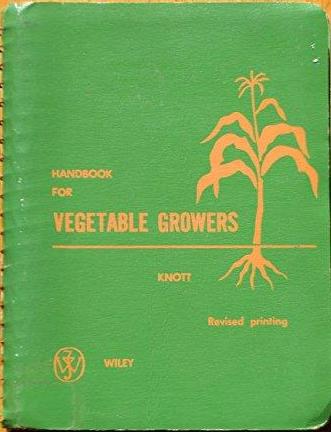
Book Recommendation -  KNOTT'S HANDBOOK FOR VEGETABLE GROWERS


This is not really a new book, but it might be a new book to most backyard vegetable gardeners.  If nothing else, just a brief scanning  of it easily  dissipates any notion that farming is a simple activity...

1957 edition.
Since it was published in 1957 by James Edward Knott, a Professor of Agriculture at the University of California, this little green, spiral bound volume has been a mainstay reference manual for commercial growers. Prof. Knott has passed on, but his  handbook has continued to find new editors.  The current edition, although dating to 1997 and still in print from Wiley-Interscience, is now edited by Donald N. Maynard and George J. Hochmuth.

Cover from latest edition (1997)
Knott's volume provides farmers with  practical  information  such as how many seeds are needed by weight or number for different spacings per acre  for specific crops. It includes comprehensive listings of pests and diseases affecting for most vegetables and the  effectiveness of  remedies (albeit usually herbicides or pesticides).  There are also tables and advise about calculating how much fertilizer or soil amendments that might be needed per acre for particular vegetables as well as data on the composition of typical manures and other organic materials, i.e. fish meal, vetch hay and buckwheat straw, that might be added to soils.

Growers can also  look up  how many  feet per minute that a tractor travels at varying low speeds starting at 1 mile per hour, or they can review charts showing how much water is needed to penetrate to difference depths in an acre based on soil type.  The handbook also covers average crop yields, what parts of a vegetable are marketable and the necessary associated storage conditions for it. There is even a section that shows the   nutrient value provided by different vegetables. For us backyard gardeners, it is an education into the complexity of the factors that farmers must take into account before, during and even after when the seeds and plants are in the ground.

In researching background information for this post, I came across a surprisingly wide variety of options about how you can get a copy of Knott's Handbook. You can buy the current edition from Wiley-Interscience for about $100 or get an Amazon Kindle edition is a little less.  Used book copies range typically from $5.00 to $20.00, but I saw one seller on eBay asking $200+ for a first edition.  I also came upon alternatives to these options that might interest the local farming community or other frugally minded types.  There are public electronic versions of the current 1997 edition available from Internet Archive as well as this PDF version available from the website of the University of Missouri's Extension Service.

FWIW:  The Internet Archive (www.archive.org) is a marvelous resource of the Internet providing open public access to millions of digital resources including folk music, videos, books etc. To get you hooked, a few of the specific resources are the Grateful Dead, Old Time Radio Shows, and TV News.  CHECK IT OUT...


And remember:

"Farming is a profession of hope." - Brian Brett, Canadian Author


WATERING VEGETABLE GARDENS & MOISTURE LEVELS


Everyone knows that plants need water, but over watering is potentially  as bad for plants as under watering.  House plants probably are at greater risk from this than  veggies in the garden because soil drainage and atmospheric evaporation   ameliorates many beginning gardener mistakes.  But let's review some basics for everyone anyway.

How much moisture:  The gardener's  old rule of thumb is that vegetables typically  need the equivalent of 1" of rain per week in order to thrive. That level of watering goes a long way to give veggies  a steady moisture level assuming your garden's soil type is loamy and includes a sufficient amount of humus (the organic components in soil that significantly abet water retention).   


For gardeners following Mel Bartholomew's Square Foot Gardening (SFG) regimens of measuring water in cups per square foot but who compromise and secretly use a hose, a standard garden hose with an adjustable wand attachment set to the "gentle shower" level or its equivalent delivers a cup of water  about every 3-4 seconds.  For those who may not be familiar with SFG, many veggie gardeners I know, including myself, consider this book to be probably the best guide  to growing in backyard venues for both new and experienced hands. Although  2013 volume is the latest edition, any second hand copy fills the bill...

Soil type or texture: The basic composition of garden soil plays a major role in how water is retained.  There are three basic soil types: clayey with the finest particle size, loams with mid size particles, and sandy with the largest size particles.  Water tends not to permeate readily  into clay soils; you will probably see it quickly pooling and/or running away on the surface from your veggies.  In sandy type soils, water drains through quickly, and so these soils tend to dry out quickly.  For loamy soils, the goldilocks of soils, water will permeate into the soil at a moderate pace giving plants more time to absorb it.  But, in all three cases, it is the  organic residues from bio decomposition that hold soil and humus particles together into various sized clumps promoting both the soil's aeration and water retention qualities. 

  fwiw: Humus only accounts for 2 - 5% of the solid weight of garden soil.

If your garden's soil is either clayey or sandy, you will need to adjust your watering frequency and amount to approximate that ideal state of 1" of rain per week.  Probably, the best approach is to  invest in a moisture meter (about $10) that will let you check the moisture of your soil at different depths.  (These meters  indirectly measure the soil's water content as reflected by conductivity. Low readings indicate low water content; high scores indicate more water.)

But, you might just want to get some idea about how fast water drains through your soil by doing your own simple percolation test.  Dig a small hole about 8 - 12" in diameter and 8 - 12" deep. Fill the hole with water and let it drain out over night to moisturize the surrounding soil. The next morning, refill the hole with water, then measure the water's depth and every two hours thereafter.  Ideally, the water level should recede about 2" every hour, but a rate between  1" and  3" per hour is okay.  

Although germinating seeds  will be just looking for moisture in the top 2" for a short time, your tomatoes, for example, at mid-season have roots that  penetrate at least 8 - 10" into the soil. When their fruit is ripening, their roots will be 18 - 24" into the soil, and you need to apply water frequently enough for it to soak down to that level.  Watering until it runs off  surface areas or pools are not necessarily  reliable indicators of sufficient watering.


Mulch, Compost and other tactics:  Soil texture and humus content are only a couple of factors affecting soil moisture level.  Other important components of the "hydrologic (i.e. water) cycle" impacting soil moisture include transpiration, evaporation, runoff, condensation and, of course, precipitation.  Some gardening techniques can be used to improve and/or stabilize moisture levels to lessen the impact of water loss from these processes.

We've already mentioned how adding biomass (via compost) into soil helps to retain water.  Mulching is another obvious technique, and your compost  can also be used as a mulch. Straw, grass clippings, shredded newspaper (albeit, messy) or leaves, or peat moss  added to the top of the soil both  insulates  against the extremes of heat or cold and also  helps soil to hold moisture by  reducing the rate of evaporation.

Reminder: Sawdust and tree bark are not ideal mulch choices because the bacteria that will be decomposing these very woody ingredients will compete with your vegetables for  the soil's nitrogen. Pine needles are not a good choice either because they can slowly increase acidity; it's better to save them for your blueberries or, better yet, your rhododendrons.

In clayey  or compacted soils, as mentioned above, water tends to runoff  instead of soaking into the soil.  You can counter this to some degree by creating raised  beds or raised rows and amending this soil by adding sand along with humus. [The larger sand particles, when they clump with bio residues from decomposition, allow for aeration and hydration of the soil.] Another tactic to  counter runoff loss is by creating  small, shallow furrows for your seeds or seedlings so that some water will collect and  gain extra time to permeate into the soil.

How much mulch is enough? 3 - 4" will reduce evaporation and insulate as well as suppress some weeds, but 6" would be even better.  Actually, even lesser amounts of mulch help --  just 2" of mulch will lower soil temperatures by a few degrees.  Recently, my  appreciation for mulch's insulating power  was reinforced.  On May 26 the thermometer read 90°F in my backyard.  I measured the soil temperature at a depth of 5" under a 3 - 4" layer of straw.  The soil's temperature was 72°F.  I also had a 4' x 4' bed without mulch (I had run out of straw) and its temperature at 5" was 78°F !  I also have a bed with just 1 - 2" of mulch (I was  running out of straw), and its temperature registered 76°F - a little better than the bare soil's. - - I need to add   mulch to these beds, obviously. 

How & when to water?  There are many ways to give plants a drink -- by hand held hoses,  watering cans, soaker or drip hoses and sprinklers as well as elaborate  timed and moisture metered systems. Your choice is probably determined by the size of your garden, your personal calendar and, of course, your budget.  I  have nine raised beds, and just run a hose through a PVC pipe under a short section of lawn to the garden. Then I water each bed as needed using a long necked wand set on "gentle shower" and water at the base of plants.  I don't mind the time I spend watering because so far:
  1.  I like being in the garden,  and 
  2.  I like being in the garden especially in the morning.  
Soaker hoses  do appeal to me. The prospect of setting up all those separate connectors between beds, getting a timer ($30) and installing hoses (200+ ft) has so far successfully detoured me from  seriously investigating  soakers.  Also, as long as I can induce friends to garden sit for me when I'm traveling, I probably will continue to avoid the issue...


I try to water in the morning,  like the good gardener who I am pretending to be,  so that any water that gets on the leaves has a chance to evaporate during the day. Watering in the evening is generally not recommended because cooler evening temperatures combined with wetted leaves can promote the growth of molds and other plant diseases.  However, I admit that it does sometimes rain at night, and plants usually seem to come through okay while lacking umbrellas or slickers - except at the start or end of growing seasons when temperatures can be a lot cooler.

Soaker hoses deliver water to the base of plants. 
Surface connectors between beds are the simplest 
way to connect multiple beds.
Watering at high noon also is not recommended. Soil evaporation and plant transpiration rates are higher, and plants are stressed by trying to cope with water loss. They are losing water through their leaves faster than their roots can absorb it from the soil.  Watering your garden at 12 Noon with the temperature at a sizzling 93°F doesn't necessarily  help the plants much because the water spraying from the hose is probably around  55°F.  This may cool the soil a bit, but the roots' absorption rate actually slows down  with the lower temperatures.  If you have stored water, e.g. rain barrels, you can use it because that water's temperature will be close to ambient temperature.

Using lawn sprinklers for watering is less desirable than even just aiming your hose at the garden from a distance  because of increased losses from evaporation during the water's short flight in the air and from droplets that collect on plant leaves. Plus, lawn sprinkler patterns always  mis-direct  some water outside of where it's needed.    I know, if you're in a hurry and/or tired,  setting up a sprinkler in the middle of the garden is hard to resist.  The sprinkler does deliver needed water; just realize that it's not efficient and  that only a brutish sort of fellow gardener will  criticize you for it.

Source: swmm.info.uk
Ollas - a traditional clay pot watering system: For those who might be on a well water system and worried about pumping your supply dry, ollas might be an option.  Ollas are porous clay pots (unglazed) without a seep hole in the bottom that are buried in the ground  near your plants. Water gradually passes through the walls of the pot keeping the soil moist at the root level. This is an ancient technique used in very dry areas. I haven't tried it yet, but I might experiment  with it this year for my pole beans.  Last year I tried burying plastic soda bottles with tiny holes punched in the sides to let water gradually out, but my top seals were not intact and no vacuum was created.  Result: the water leaked out too fast... Using clay pots, you don't need to worry about vacuums... If I remember to try ollas, I'll report back later in the year.  [Or, if anyone reading  this post has experience using ollas, I hope you'll submit a comment.] Additional information about making your own ollas is available from the Global Buckets website.  


And remember...

"There's nothing like listening to a shower and thinking how it is soaking in around your green beans." -- Marcelene Cox