WATERING VEGETABLE GARDENS & MOISTURE LEVELS
Everyone knows that plants need water, but over watering is potentially as bad for plants as under watering. House plants probably are at greater risk from this than veggies in the garden because soil drainage and atmospheric evaporation ameliorates many beginning gardener mistakes. But let's review some basics for everyone anyway.
How much moisture: The gardener's old rule of thumb is that vegetables typically need the equivalent of 1" of rain per week in order to thrive. That level of watering goes a long way to give veggies a steady moisture level assuming your garden's soil type is loamy and includes a sufficient amount of humus (the organic components in soil that significantly abet water retention).
For gardeners following Mel Bartholomew's Square Foot Gardening (SFG) regimens of measuring water in cups per square foot but who compromise and secretly use a hose, a standard garden hose with an adjustable wand attachment set to the "gentle shower" level or its equivalent delivers a cup of water about every 3-4 seconds. For those who may not be familiar with SFG, many veggie gardeners I know, including myself, consider this book to be probably the best guide to growing in backyard venues for both new and experienced hands. Although 2013 volume is the latest edition, any second hand copy fills the bill...
Soil type or texture: The basic composition of garden soil plays a major role in how water is retained. There are three basic soil types: clayey with the finest particle size, loams with mid size particles, and sandy with the largest size particles. Water tends not to permeate readily into clay soils; you will probably see it quickly pooling and/or running away on the surface from your veggies. In sandy type soils, water drains through quickly, and so these soils tend to dry out quickly. For loamy soils, the goldilocks of soils, water will permeate into the soil at a moderate pace giving plants more time to absorb it. But, in all three cases, it is the organic residues from bio decomposition that hold soil and humus particles together into various sized clumps promoting both the soil's aeration and water retention qualities.
fwiw: Humus only accounts for 2 - 5% of the solid weight of garden soil.
If your garden's soil is either clayey or sandy, you will need to adjust your watering frequency and amount to approximate that ideal state of 1" of rain per week. Probably, the best approach is to invest in a moisture meter (about $10) that will let you check the moisture of your soil at different depths. (These meters indirectly measure the soil's water content as reflected by conductivity. Low readings indicate low water content; high scores indicate more water.)

But, you might just want to get some idea about how fast water drains through your soil by doing your own simple percolation test. Dig a small hole about 8 - 12" in diameter and 8 - 12" deep. Fill the hole with water and let it drain out over night to moisturize the surrounding soil. The next morning, refill the hole with water, then measure the water's depth and every two hours thereafter. Ideally, the water level should recede about 2" every hour, but a rate between 1" and 3" per hour is okay.
Although germinating seeds will be just looking for moisture in the top 2" for a short time, your tomatoes, for example, at mid-season have roots that penetrate at least 8 - 10" into the soil. When their fruit is ripening, their roots will be 18 - 24" into the soil, and you need to apply water frequently enough for it to soak down to that level. Watering until it runs off surface areas or pools are not necessarily reliable indicators of sufficient watering.
Mulch, Compost and other tactics: Soil texture and humus content are only a couple of factors affecting soil moisture level. Other important components of the "hydrologic (i.e. water) cycle" impacting soil moisture include transpiration, evaporation, runoff, condensation and, of course, precipitation. Some gardening techniques can be used to improve and/or stabilize moisture levels to lessen the impact of water loss from these processes.
We've already mentioned how adding biomass (via compost) into soil helps to retain water. Mulching is another obvious technique, and your compost can also be used as a mulch. Straw, grass clippings, shredded newspaper (albeit, messy) or leaves, or peat moss added to the top of the soil both insulates against the extremes of heat or cold and also helps soil to hold moisture by reducing the rate of evaporation.
Reminder: Sawdust and tree bark are not ideal mulch choices because the bacteria that will be decomposing these very woody ingredients will compete with your vegetables for the soil's nitrogen. Pine needles are not a good choice either because they can slowly increase acidity; it's better to save them for your blueberries or, better yet, your rhododendrons.
In clayey or compacted soils, as mentioned above, water tends to runoff instead of soaking into the soil. You can counter this to some degree by creating raised beds or raised rows and amending this soil by adding sand along with humus. [The larger sand particles, when they clump with bio residues from decomposition, allow for aeration and hydration of the soil.] Another tactic to counter runoff loss is by creating small, shallow furrows for your seeds or seedlings so that some water will collect and gain extra time to permeate into the soil.
How much mulch is enough? 3 - 4" will reduce evaporation and insulate as well as suppress some weeds, but 6" would be even better. Actually, even lesser amounts of mulch help -- just 2" of mulch will lower soil temperatures by a few degrees. Recently, my appreciation for mulch's insulating power was reinforced. On May 26 the thermometer read 90°F in my backyard. I measured the soil temperature at a depth of 5" under a 3 - 4" layer of straw. The soil's temperature was 72°F. I also had a 4' x 4' bed without mulch (I had run out of straw) and its temperature at 5" was 78°F ! I also have a bed with just 1 - 2" of mulch (I was running out of straw), and its temperature registered 76°F - a little better than the bare soil's. - - I need to add mulch to these beds, obviously.

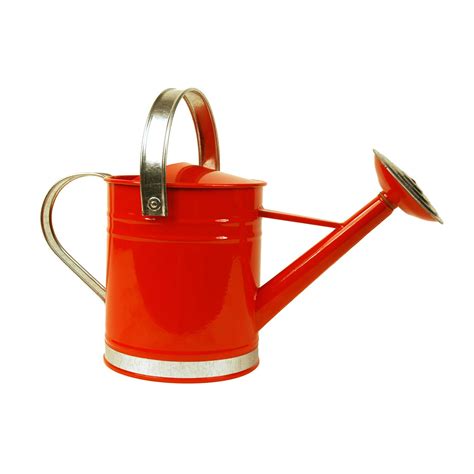
How & when to water? There are many ways to give plants a drink -- by hand held hoses, watering cans, soaker or drip hoses and sprinklers as well as elaborate timed and moisture metered systems. Your choice is probably determined by the size of your garden, your personal calendar and, of course, your budget. I have nine raised beds, and just run a hose through a PVC pipe under a short section of lawn to the garden. Then I water each bed as needed using a long necked wand set on "gentle shower" and water at the base of plants. I don't mind the time I spend watering because so far:
- I like being in the garden, and
- I like being in the garden especially in the morning.
Soaker hoses do appeal to me. The prospect of setting up all those separate connectors between beds, getting a timer ($30) and installing hoses (200+ ft) has so far successfully detoured me from seriously investigating soakers. Also, as long as I can induce friends to garden sit for me when I'm traveling, I probably will continue to avoid the issue...
I try to water in the morning, like the good gardener who I am pretending to be, so that any water that gets on the leaves has a chance to evaporate during the day. Watering in the evening is generally not recommended because cooler evening temperatures combined with wetted leaves can promote the growth of molds and other plant diseases. However, I admit that it does sometimes rain at night, and plants usually seem to come through okay while lacking umbrellas or slickers - except at the start or end of growing seasons when temperatures can be a lot cooler.
 |
Soaker hoses deliver water to the base of plants.
Surface connectors between beds are the simplest
way to connect multiple beds.
|
Watering at high noon also is not recommended. Soil evaporation and plant transpiration rates are higher, and plants are stressed by trying to cope with water loss. They are losing water through their leaves faster than their roots can absorb it from the soil. Watering your garden at 12 Noon with the temperature at a sizzling 93°F doesn't necessarily help the plants much because the water spraying from the hose is probably around 55°F. This may cool the soil a bit, but the roots' absorption rate actually slows down with the lower temperatures. If you have stored water, e.g. rain barrels, you can use it because that water's temperature will be close to ambient temperature.
Using lawn sprinklers for watering is less desirable than even just aiming your hose at the garden from a distance because of increased losses from evaporation during the water's short flight in the air and from droplets that collect on plant leaves. Plus, lawn sprinkler patterns always mis-direct some water outside of where it's needed. I know, if you're in a hurry and/or tired, setting up a sprinkler in the middle of the garden is hard to resist. The sprinkler does deliver needed water; just realize that it's not efficient and that only a brutish sort of fellow gardener will criticize you for it.
 |
| Source: swmm.info.uk |
Ollas - a traditional clay pot watering system: For those who might be on a well water system and worried about pumping your supply dry,
ollas might be an option. Ollas are porous clay pots (unglazed) without a seep hole in the bottom that are buried in the ground near your plants. Water gradually passes through the walls of the pot keeping the soil moist at the root level. This is an ancient technique used in very dry areas. I haven't tried it yet, but I might experiment with it this year for my pole beans. Last year I tried burying plastic soda bottles with tiny holes punched in the sides to let water gradually out, but my top seals were not intact and no vacuum was created. Result: the water leaked out too fast... Using clay pots, you don't need to worry about vacuums... If I remember to try ollas, I'll report back later in the year. [Or, if anyone reading this post has experience using ollas, I hope you'll submit a comment.] Additional information about making your own ollas is available from the
Global Buckets website.
And remember...
"There's nothing like listening to a shower and thinking how it is soaking in around your green beans." -- Marcelene Cox