Showing posts with label Lettuce. Show all posts


GARDEN PREPARATION: MAY 


                                                           THINK INSECTS - You need more than you think
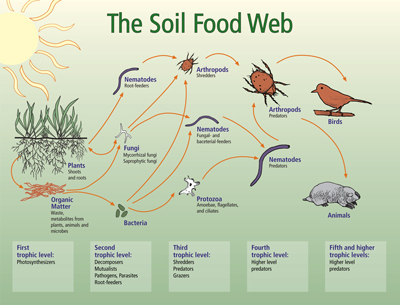


Most of these critters are beneficial. Source: USDA
All too frequently, I fear,  a few new gardeners, who may have never before put a spade into soil, might think all  insects  with the possible exception of pollinating bees, are pests. Another frequent error of beginnig gardeners is  that some of their tilling methods kill both benevolent soil insects and microbes residing in garden soils either by burying them deeply or by compacting the soil so that they can neither dig out of it or make  a home by burrowing into it.  Why does this happen?

Gardens, of course,  are  not natural environments.  Most of our ornamental plants and vegetables are not native, and usually our yards are either devoid of or are not adjacent to  natural areas where  birds and insects can reside.  This means that gardeners are compelled to try to impose their own "balances of nature" in their yards and gardens.   

One  consequence is that lots of money gets spent  on insecticides to protect plants from being devoured by particular (usually also non-native) "bugs" that have specialized to  feast on specific  vegetables.  Unfortunately, these chemicals - even the "organic" ones - usually also kill benevolent  insects along with other useful arthropods in additon to the real vegetable villains. These collateral casualties typically include ants, millipedes, springtails and spiders.  This document  from the  U. S. Dept. of Agriculture  identifies some of the most common and overlooked critters that get murdered.

So, what should a conscientious  backyard gardener do to minimize  environmental damage  as he/she prepares their future weed patch this spring?


Here are a few things to keep in mind to reduce your guilt load and help nature:

  • Start doing low tillage - If your garden in already established, stop rotor-tilling or deep spading. Just work the top couple of inches or even better, add compost and/or straw on top.  Eventually,  you will be able to just add a mulch. Your back will grateful.
  • Increase the mulched areas around your shrubs using natural products: forego the shredded  and dyed automobile tires.  Shredded tires last a long time, but they also contain various heavy metals.
  • Use more native plants for landscaping to attract birds & beneficial insects.
  • Feed birds - Although we  prohably don't want to attract more caterpillars into our vegetable patches for the sake of our feathery friends, birds should be in our gardens because are very effective insect controllers. I have feeders set up near my garden, and the birds tend to top off their feeder meals with insects for dessert.  I have not used insecticides for decades.
  • Minimize use of commercial insecticides and petroleum based fertilizers.  I am glad to see more organic products gaining shelf space in garden centers.  Using less of these products in our yards is collectively, perhaps, the most important envionmentally friendly thing we can do.  

End of this month's soapbox.... 

Enjoying Early Greens & Saving Space


 Submitted by Nancy Scott, Rensselaer County Master Gardener

Photos by N Scott

It certainly has been cold, windy and rainy these past few weeks.  Veteran gardeners have been waiting for spring to really start. Inside, many people have been coddling tomato, pepper and other warm weather veggies, under lights. But hopefully, some of you have been able to get a few lettuce, spinach and pea seeds in the ground.

For the past 5 years I have been growing veggies in various sized planters.  I looked to the guru of smaller planting spaces, Mel Bartholomew of Square Foot Gardening fame, for guidance.  I’ve embraced most of his ideas, but for me, his tenet of just a few plants in a square wastes a lot of potential for some vegetables. When I plant greens, I’ve found sowing a bunch of seeds and then thinning them is a lot more fun and gratifying.

One example is lettuce seeds. In an area about I foot square, I widely sow at least 20 seeds.   About 2 weeks later, I sow another area and continue as the season progresses.  As the plants begin to come up and start to crowd each other, I start thinning them.  Eventually, you’ll be left with a few plants with the proper spacing. These can then be allowed to grow to maturity. The same can be done with spinach, beets, chard, kale, radishes, arugula, escarole, and probably many more.  Yes, tiny radish seedlings are tasty.

When harvesting, simply snip the plant off, leaving the roots (and dirt). Wash the leaves, drain, refrigerate and add to your salads or stir-fries.   This method does require frequent maintenance, but seeds are much cheaper than transplants and you get to harvest much more! Enjoy.


And Remember...

"Nature does have manure and she does have roots as well as blossoms,

 and you can't hate the manure and blame the roots for not being blossoms." Buckminster Fuller


Garden Preparation - May


The excitement levels of backyard gardeners increasewith each passing day of May, but try to contain that excitement because a late heavy frost can dash your expectations throughout the month.  However, here are a few things you can do...

  • Sow seeds for  cool hardy veggies in the garden; peas, beets, cabbage spinach, chard etc., but check the soil temp just in case. These fellows will deal with soils in the 50°F range, but don't let your excitement think that you can sneak in bean seeds much less set out those tomatoes and pepper plants you just bought from the big box store.
  • If you already have set out cool hardy plants, then you might want to start checking for cutworms, slugs and even flea beetles. If your seeds have sprouted, think about thinning.
  • Towards the end of this month, remember to move your seedlings out of the cellar during the daytime to harden them to the real world. Keep your eyes on the weather forecasts because you may not want to leave the plants out over night.  What you are really doing is exposing the plants to the spring breezes that will motivate them to streghten their stems.
  • There's still time to start seeds for some of the warm weather lovers like cucumbers, melons and peppers indoors.  If you also starting lettuce, remember to keep it cool (under 70°F) and shaded - otherwise the seeds will stay dormant and not sprout.

Veggie History - Lettuce [Lacuca sativa]


Romain types were some of the earliest  varieties
  probably developed by the Eqyptians.
Botanists believe that lettuces, botanically part of the daisy family, Asteraceae, derives from a wild variety in Asia Minor and may have been first cultivated by the Egyptians and the farmers in Mesopotamia. The wild variety probably resembled celtuce - a stem type that we now think of as an Asian vegetable (commonly called: Chinese or asparagus lettuce), but it was likely introduced into China between 400 and 600 AD. The Greeks and  Romans liked the cultivars that the Egyptians had developed and added  lettuces to their menues. Eventually the Romans introduced lettuces to Britain. The Romans, of course, evacuated Britain, but the lettuces stayed.


Celtuce


    • Celtuce is a great cool weather plant. You can start it indoors a month before the last frost or directly seed it into the ground. It is robust enough to sprout even when soil temperatures are just 40°F.  Space seeds 1" apart and thin to 8" spacing. Harvest when  plants reach 8-10", or you can let them to full size (about the size of a Brussel sprout),   full cooking.  If you want full size plants, spacing needs to be increased to 18."  Both leaves and stauks are editable.


In England the Elizabethans grew both a few head and leaf varieties, and  early New England colonists mention lettuce seeds in their diaries  as early as the 1630s. By the end of the 18th century in New England, "market gardeners" near coastal urban areas like Boston that offered  ready supplies of animal (as well as  seaweed) manures learned to grow lettuces and other seasonal crops on their southern slops to sell to city dwellers.   In Virginia Thomas Jefferson grew Dutch Red, a loose head variety, but like many gourmands of those times and earlier, he  preferred lettuce to be either boiled or sautéed.  Lettuce in salads was sometimes also eaten with simple vinegar dressings, but fresh salads remained restricted to upper class  menues until practically the end of the 19th century. Starting early in the 20th century lettuce in fresh salads spread around the globe.


And remember...

"The metaphor of the melting pot is unfortunate and misleading. A more accurate analogy would be a salad bowl, for,
 though the salad is an entity,  the lettuce can still be distinguished from the chicory, 
the tomatoes from the cabbage." -  Carl N. Degler


Microgreens vs Kale?


I  recently listened to a couple of Rensselaer County farmers talk about the challenges they face anticipating the whimsical buying habits of their farm stand customers (i.e. food eaters) from one year to the next.  Both said that they had learned only to add new varieties or to expand existing crops very, very judiciously because the public generally did not  remember what it had asked the farmers to grow from one year to the next. 

As part of that conversation one  the farmers also commented  that he's  noticed a recent fall off in the demand for kale - the wonder veggie    constantly  promoted by foodie media  since  perhaps Gutenberg's invention -  along with what seems to be an  exponentially expanding public craving for microgreens. He admitted that he's now   starting  to wonder if he should cut back a little on kale and expand his microgreens, but he is not yet ready to alter his plans for the coming year. The farmer didn't speculate on the reasons for the perceived  changes in demand, so let's now attempt sp,e speculation  of our own.

The Local Outlook  

Farmers' markets focus on fresh foods, not necessarily convenience.
The increasing demand for microgreens as well as  the  probable persevering attraction of kale, I think,      reflects the ongoing demographic trends of  Renssealer County as well as the rest of the Capital District.  Suburban areas are still sprawling and   apartment living in towns and cities is noticeably increasing. The folks making these transitions  seem to be either young professionals or recent retirees. Both groups are educated and have stable incomes; and  both  share a heightened interest in at least  attempting to follow healthier eating habits. The ever busy lifestyles of these new suburbanites and townies also mean that  convenience and efficiency in  their food choices are valued whether they are in dining in or dining out.   Microgreens fit nicely into these parameters.  Unlike kale, preparation time for microgreens is minimal because it is usually  devoured raw - the smallest microgreens are sprinkled into or onto something, and the larger sizes are ready to go salad mixes.  There is, simply,  no waste left after you clean your plate!

The pattern matches that of what a UCLA research group found in 2014 after tracking how 32 families used the rooms in their houses. These home owners used the kitchen and an adjourning open dining area the most, but they were hardly ever in those rooms together at the same time.   Few sit  down meals were prepared; it was mostly a grab, eat  and go environment.  I suspect a similar pattern might  be true for new the apartment dwellers who discover how easy it is to catch a meal from a nearby deli or pub.  The implication  for farmers (easy, of course, to say) is that they need to continue to focus on establishing supply relationships with restaurants, food cart vendors, delis etc as the principle way to plan for expanding their crops.  Direct selling via roadside stands and farmers' markets probably will  increase also as some  people shift to the suburbs, but  will probably only  provide    incremental increases in roadside retail sales. The same situation  probably holds true for the larger local farmers' markets - more people seem to becoming to these venues, but food vendors and distillers seem to be increasing in number faster  than either the  number or size of farm stalls. 

Microgreens

Microgreens  cover a wide range of plants, typically those from the brassica (the mustard family  that includes cabbages, broccoli etc.) and the lactuca family (lettuces), but really any young plant that appeals to someone's taste buds [e.g. cress, sorrel, purslane etc.] can be fitted to the label.

The current high interest in microgreens may stem from the appearance of a 2012 research article  in the Journal of Agricultural and Food Chemistry that reported finding  notably higher concentrations of nutrients in these young plants  compared with their mature counterparts.  In a few cases nutrient levels  as much as 40 times higher  were discovered!  The result is that microgreens now seem to flood farmers' markets  and appear  to take up more pages in seed catalogs than tomatoes!

For farmers, the principle attraction of microgreens is their short time to harvest: typically 20 - 40 days  easily allowing for multiple staggered  plantings resulting in almost continuous harvesting and sales.  They can be grown either in greenhouses or outdoors in raised beds within or without tunnels, and they grow at cool temperatures.  In our area that means growers can easily produce them year round.

Their planting density, however, does make them subject to   diseases such as damping off and phytothera; and  their seed and labor costs are high compared with many field crops. Despite these drawbacks, overall production costs are less than the costs associated with such farm equipment such as tractors etc. A farmer devoting 60 sq ft of greenhouse space and using a 4 rack system with plantings staged  for  two week harvesting will produce about 50 lbs of microgreens over the course of a year.  With  microgreens retailing for around $28/lb  at local farmers' markets, a farmer potentially can earn a steady return from a small amount of space.

For backyard gardeners, with small greenhouses or grow lights in the cellar,  microgreens  also are  a  tempting crop. The yields may seem small, as I will personally attest, but the harvest is satisfying for the required effort.  Microgreens are harvested when between 2" and  4" high, and that means that a common 10" x 20" seeding tray may yield between 5 - 6 oz. of microgreens - enough for a backyard gardener in the winter to enjoy a couple of  fresh salads with someone special occasionally.  A fancy, 4  rack set up with grow lights for the well-heeled home gardener  can easily cost $1,000+ [the equivalent of buying 35+ pounds of microgreens retail]. A single tray of microgreens on a window sill is clearly a cheaper alternative, but the fugal grower is  more likely to experience some leggy plants and uneven growth despite  her/his  best efforts. 

Kale

According to webMD kale is actually more popular than ever and well deserving of its reputation as a super food. If you need convincing of  its nutritional value beyond that implied by its unadulterated taste when eaten raw, look no further than this chart from the World's Healthiest Food Organization.  It  seems to me, however, that eating kale clearly is  superior to taking a spectrum supplements from vitamin bottles.  Kale is, after all, the forage  of choice for  many ruminants when they can get it.

When  I was growing up, I never heard of kale; but my family was not particularly adventurous when it came to foods. Meat and potatoes was our norm for almost every dinner. Now, however, having acquired a taste for kale,   I  add it joyfully  into omlets, soups, stews and use it  sautéed as a side dish.  These all do entail cooking kale - an aspect that perhaps dissuaded my mother from adding it as another  dish to our menu...

For both farmers and backyard gardeners growing kale is relatively easy and economical.  A first harvest is ready usually within 60 - 75 days, and a second planting started during mid summer will yield its leaves through December or longer. In large gardens kale is grown  outdoors in rows  36" apart with plants spaced at 12" - 18."  For small backyard gardens if you just want to have a few kale leaves at a time, then a single plant might suffice. You can plant it in late spring and pick leaves from mid-summer to New Years. Kale  is  relatively disease resistant and is not especially appealing to most insects.   Cabbage moths may be attracted to it, but casual observations in my own garden indicate that even these moths prefer regular cabbages and broccoli if given a choice.  Over the course of a growing season a single kale plant such as Winterbor (a curly leaf variety) or Tuscano (a straighter  curled leaf type) will produce between 4 - 6 lbs of leaves - usually enough to satiate one adult kale convert.  


And remember...

What happens when you buy too many greens?  You tip the skales...


JUNE - GARDEN PREPARATION

Another month and still lots of garden  work to do [depressing sometimes thinking about it, isn't it], but some of us are near to or maybe already enjoying our  first harvests and breathing sighs of relief as early sowings  finally  emerged  and started to grow. In Rensselaer County, according to Cornell data, our growing degree days  finally  reached their recent 15 year average levels around May 7 after lagging behind  10 - 12 days from recent  years. In short, April  and early May stayed darn cool.

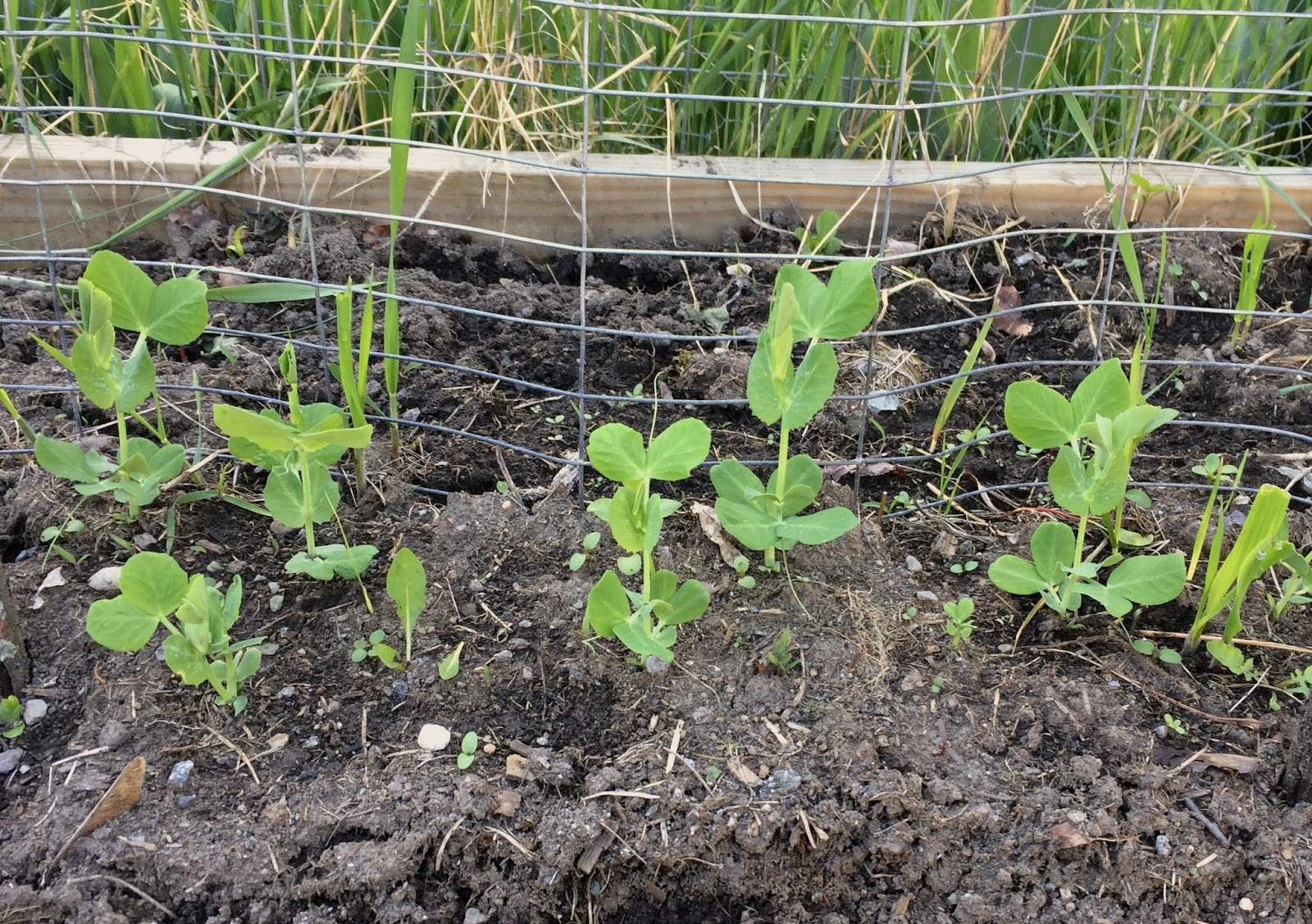
Sugar snap peas - still catching up from a cool May
The peas I planted April 8 when the soil temperature registered a promising 47°F  and with an all too   optimistic forecast of continuing warmer seasonal temperatures finally  emerged on May 3. Their germination  hesitation caused by almost 3+ weeks of very cool temperatures  with essentially no accrual of growing degrees. When the seeds did germinate  after several unusually hot days at mid-month, air temperatures promptly retreated and hovered  in the 40 - 50°F range. My  peas are just now deciding to catch up. The other cool weather plants that I set out  later in May to make room in  the cellar  for my happily growing tomatoes and cucumbers  also persevered and are finally  now  starting  to  show signs of responding positively to being in the great outdoors. On the plus side for this spring's weather is that both weeds and insect pests seem also to be emerging late.

So much for last month, now moving on to June...


    Rhubarb, a vegetable that used in pies goes well with vanilla ice cream.
  • If you're luckier than me and happen to live in a warmer nook of Rensselaer County, you might be harvesting spinach, lettuce and radishes by now. So far, I am just limited to relishing my rhubarb and horseradish...
  • Assuming you may have already planted some bush beans, beets, and squash at the end of May, you should think about follow on plantings of the same.  If you've just planted these fellas, wait another 10 - 12 days, then plant more. It's almost guaranteed, that whenever you sow seed or set out plants that   bumper crops will be ready for picking back home  on the third day of your long awaited get away to Nantucket... Don't worry about it. Be generous and ask a neighbor or friend to enjoy your harvest and maybe also to water your garden too as part of the deal...
  • Early June is also the time to set out the full complement of  warm weather veggies: basil, tomatoes, eggplant, cucumbers, peppers etc. for harvesting  later in August and September. Thanks to less disciplined gardeners than ourselves,  big box stores and nurseries might be sold out of these plants by early June, but local farmer markets will probably continue to offer a wide variety stock - and probably better acclimated stock.  
  • The next suggestion might seem slightly depressing, but later this month is also  time to start seedlings for late summer or autumnal   bounty.  Pick your favorite cabbage family member - cabbage, broccoli, kale etc. and get started.  
  • Follow on plantings of lettuce, however,  are a special case. Start mid-summer varieties such as Starfire (a green leaf),  Sparx (a Romaine heart)  or Adriana (a green butterhead) now. These can probably be sown   directly in the garden because it's still (hopefully) not too hot.  For late season lettuces  such as Miro (a green butterhead), Skyphos (a red butterhead) or Green First (a green Romain) you need to wait until mid or late July and start them indoors where it's hopefully cooler.  The heat tolerance of lettuce is relative.  The mid and late season varieties are a little less likely to bolt as quickly as early season types, but no lettuce really likes summer. For these follow on plantings you may need to provide a sun screen if you don't have a partially shaded garden area for them.  Direct seeding of lettuce during July and August is frequently not successful because the seeds  respond to high soil temperatures by going dormant for the rest of the season.
  • On an even more  depressing note, the next topic is WEEDS...  Where to start? By June many weeds are already well underway.  For gardeners with only a couple of small raised beds, weeds are no big deal - although for all gardeners they are like proverbial dragon's teeth  poping up overnight every night.  Mulching,  fabric cloth, and hand tilling  probably effectively   manages them for most of us.  Controlling weeds organically in larger gardens and in field environments  is more challenging due to scale - just ask any grower at your local farmer's market on Saturday. For those gardeners wanting to know what weeds they are pulling and wishing to expand their garden libraries, books identifying weeds are as multitudinous as weeds!  For our neck of the woods, Weeds of the Northeast (1997) is the classic and still remains in print from Cornell University Press.  Of course, a Google search using the phrase, "weed identification pictures" probably serves the ID purposes of most gardeners.  And for those few gardeners  who may want to pretend to be botanists, a source  providing a botanical approach to weed identification is  Weed Identification Tools and Techniques from Virginia's Extension Service. This doesn't tell you what your weed is, but instructs you how to analyze your mystery plant like a pro.  If you still remain stymied, send a photo via email or  bring a specimen of the plant to your county Extension  office for identification.  As a final note about weeds, perhaps the ultimate solution is to eat them.  For an interesting list of what's edible beyond dandelions, purslane and (maybe) garlic mustard, checkout the  Edible Wild Food site. 


And remember...

"Weeds are flowers too, once you get to know them." - A. A. Milne

VEGETABLE VARIETIES FOR GARDENERS (VVfG)

  
VVfG is a citizen science project developed  by Cornell University's Cooperative Extension 
to collect and share data about growing vegetables in New York State.
------------------------------------------------------------------------------------------------------

Last Year's Experience: Lettuce, Tomatoes & Basil


Last year my Master Gardener companions, Mimsy Pye, Marge Davey and I, experimented with Bed Number 1.  The Spring Plantings consisted of 3 varieties of leaf lettuces: Buttercrunch, Black Seeded Simpson, and Blade.  Because it was mid–May before we were able to plant the rows, we decided to put them along the outer edges of the 4ft by 4ft bed leaving room for the summer crop of tomatoes and basil in the bed's center.  

It was interesting to compare the 3 varieties --  all planted at the same time and all growing under the same conditions.  The ‘Black Seeded Simpson’ by far out-performed the other 2 as far as yields.  However, it really did not have much flavor.  If you prefer the taste of your salad dressing, then this was the one for you.  ‘Buttercrunch’ had a mild buttery taste, with the best texture, forming more of a rosette type loose head. Dark red ‘Blade’ had a poorer germination rate, but was the most flavorful.  Red colored lettuces have more antioxidants and micronutrients than just plain green ones.   As it matured it did have a little more of a bitter flavor, but not as much as an escarole or radicchio.

I think that it is worth noting that caring for these lettuces would have been different if they were in my home garden.  At home, one can easily check their garden every day or two, even with a busy schedule. The Demonstration Garden was not as convenient.   Thinning should be done on a regular basis, so that you have the benefits of nice tender baby lettuces, making room for the other plants to spread.  Too many plants together get leggy, with some leaves getting slimy.   

Jasper on left responded to warming weather faster than the Brandywine on right.
With the lettuces still growing, we planted a ‘Jasper’ cherry tomato and a ‘Brandywine’ heirloom tomato, as well as ‘Genovese’ and ‘Thai Sweet’ basil at the end of May. Last year’s spring in our neck of the woods was wet and cool.  This was good for the lettuces, but not the tomatoes and basil.  As the weather finally warmed, the tomatoes responded.  

The contrast between the two plants was quickly evident.  The heirloom ‘Brandywine’ struggled to overcome the wet, cool spring.  It quickly developed early blight and remained somewhat stunted.  It produced very few fruits, with the earlier ones having little flavor.  The last one picked in a gloriously warm October was large and fabulous. It was so sweet and juicy with a deep rich tomato flavor.


  ‘Jasper’, an indeterminate new hybrid variety, outpaced the heirloom.  ‘Jasper’s’ disease resistance includes Early Blight, Septoria leaf spot, Fusarium wilt and Late Blight.  The plant quickly outgrew its 5 ft stakes by a good 2 ft.  It was covered with clusters of ¾ inch round, red fruits.  The taste was flavorful and sweet, but not quite as sweet as ‘Sungold’.  Harvesting at first was a little tricky.  Trying to pick the individual fruits caused them to split, making it easy to pop into your mouth, but hard to donate.  Snipping off the whole cluster kept them beautifully intact, and they kept quite well for a few days.  Like most cherry tomatoes, one plant is all you really need.


The two basils struggled with the cool, wet conditions as well.  A few days of high temperatures in late spring caused them to go to seed.  Even with pruning, the ‘Thai Sweet’ never really recovered and had poor yields.  The “Genovese” did better, but it later became shaded by the ‘Jasper’, which also impacted its yields.  Frequent pruning can extend a basil plant’s life, but at some point it will get leggy and just keep producing flowers.  Again, a home gardener would constantly be doing this, adding the trimmings to some delicious dish. Once cut delicate herbs like basil don’t travel well, making them difficult to donate.  

Pskem River garlic, early spring 2018.
Cornell also called for a fall planting of  ‘Pskem River’ garlic but which they did not provide.  ‘Pskem River’ is a hard necked variety from Uzbekistan.  It has large purplish cloves, maybe 3-5 cloves per bulb.  It is supposed to have a strong flavor and grow well in our area.  I waited too long to buy it on line and it was sold out. However, I was delighted to find it at my local food co-op. 

After cleaning up the tomatoes and basil in mid-October, the soil was prepped and along with a dusting of bone meal, the large bulbs were pressed into the soft earth.  I am happy to report that they made it beautifully through the winter, even though they were not mulched. 
(More on garlic in a later post.) 


 So, that was last year’s experiment.  I can’t wait to see what this growing season will bring.


Text and photos submitted by Nancy Scott, Rensselaer County Master Gardener