Sun Scorch and Trench Composting


Sun scorch. It's okay to eat with a little trimming.
Source: gardeningthehudsonvalley.com
So far August's weather leaves a lot to be desired - way too much rain and  very hot streaks followed by cooler and wet nights.  Although this has been good for my compost piles, it has badly affected my tomatoes and a number of other veggie favorites although the winter squashes seem to like it. 

The excess moisture results in cracked tomatoes that are then exposed to bacterial infections.   Although  tomato vines grow okay in temperatures that reach into the low 90°s,  their fruit ripens best with temperatures in the 70°s! If you've been wondering why your fruit has been slow to ripen, that's the reason.  Want a little more info? Check this note from Cornell's Vegetable Program website.

If you have over pruned your tomato vines or removed too many leaf stems to let more sun light shine on the fruit to hasten ripening, SURPRISE, you may be creating the conditions for "sun scorch."  High temperatures actually inhibit the production of the pigments that provide the glorious tomato red gardeners look for... Oh, well.

Trench Composting

A full trench ready to be covered.
Source: flowering.com
If you have a small garden AND possibly have some space in it now from your pulling up your blighted tomato vines or sun scorched fruit AND you still do not have a compost pile, now is the time to reserve a little of your precious  gardening space for compost.  Dig a trench about 12" deep (or just a small pit in a raised bed) leaving the excavated soil to one side and start dumping your vegetative table scraps into it. If you don't like the looks, simply cover the scraps with the soil that you left  along the side.  The  scraps will get a good start on decomposing.  In the spring, even if your trench is not full, plant a favorite vegetable parallel to the trench to benefit from the added nutrients.  

Another approach to composting directly in your garden is called the "sheet" method.  Gardeners simply scatter their table scraps around the garden and then gently till them into the soil throughout the season. I do this with coffee grounds,  but I prefer trenching (or using a pit)...  

FWIW:  Note that this photo shows corn cobs and corn husks as well as other whole fruits and vegetables. Leaving items whole will slow down their decomposition.  Corn cobs and husks will take 2+ years to rot. It's much better to to cut these scraps or stale vegetables into pieces to expedite composting.


And remember:

"Kings and cabbages go back to compost, 
but good deeds stay green forever." - Rick DiMarinis, American author

Why Weeds Win -  A Brief Tribute

Weeds in charge. Photo by I.  Stephens
When you see a garden out of control and its vegetables are hidden among the weeds, it's easy to suspect a "lazy gardener." But, as experienced gardeners know,  the odds are really in favor of the weeds to win. New gardeners generally just don't realize  how much the deck is stacked against  them.  

As soon as any  gardener starts spading and clearing a plot for vegetables, that gardener actually is creating  ideal conditions for many plants (in this case, weeds) whose seeds have just been patiently waiting - maybe for a few days, a month, a year, ten years or even decades to get started.  Plants have evolved their reproductive patterns to accommodate  the vagaries of climate, soil and the flora and fauna in their environments. Our backyard environmental disturbances in the soil just  fit nicely into their coping strategies. Although gardeners may occasionally curse about  weeds, the resourcefulness of these plants to cope with whatever Mother Nature or homo sapiens throws at them deserves a lot of respect. --  And, knowing what I'm up against also does provide  me with some solace... occasionally.

FWIW:  Most of our common garden weeds were introduced by the early colonists, i.e. the Puritans et al, whose saved garden seeds and animal fodder also contained the seeds of our familiar weeds. 

Most plants rely on   the shotgun approach when it comes to seed production - the more seeds produced, the better chance that at least 1 seed will survive and be able to grow. The following two factoids  clearly  delineate  what gardeners are really up against and why weeds will out live us:

Common purselane - 2,000,000 seeds per plant.    Seeds viable for 20 - 25 years

Eastern black nightshade - 800,000+ seeds per plant.  Seeds viable for 40+ years

I could cite more, but it would get repetitive and be more depressing. Plants use various strategies to get their seeds dispersed such as  wind, water, edible fruit  and even exploding pods. Many plants also employ other propagation methods:
  • Stolons, commonly called runners, - these are above ground stems that can set roots, e.g. crabgrass (yuck) or strawberries (yum); 
  • Rhizomes - underground stems that can sprout above ground stems, e.g. quack grass, wild morning glory,  and bindweed;
  • Spores - a complicated cycle used by some non-flowering plants such as  ferns. [Conifers, however, (i.e.  evergreens) are also non-flowering, but do develop seeds in cones.]                                       
The seeds naturally  found in  soil are referred to as the "weed seed bank." Although some plants also use stolons or rhizomes to reproduce, they chiefly rely on seeds; and it's the seeds that we are up against.  The Iowa State U. diagram of the "weed seed bank" below shows what the weed cycle looks like.  
Iowa State University

What  the diagram does not convey is the cycle's real complexity.  Some seeds need to be buried first under the soil and be dormant for varying periods of time. They will not sprout until they are uncovered.  Others need to be exposed to cool temperatures or to specific moisture levels before sprouting.  Still others, need to stay on the surface and experience warm temperatures to become dormant for next year. 

Seeds in the soil bank get moved around by different means such worms, insects, burrowing animals and  human cultivation. Birds  and  other animals eating a fruit and/or an entire plant will distribute seeds away from the mother plants after the seeds pass through their digestive tracks.  

Strategy for Weed Control Without Herbicides

Unfortunately, the strategies for controlling weeds boil down to two that gardeners naturally do:
  • Plant removal before  seed cycles develop, and      
  • Sprout suppression.      

Reducing the  weed seed count in your garden plot is achievable, but entails a multi-year effort.  Landscaping cloth (sometimes now called "weed cloth") is effective in suppressing weeds, but may complicate your efforts to use compost.  Using just mulch will do the job, but can take a number of years to become an effective  barrier assuming your mulch is weed seed free.  Probably the best approach is to use a landscape cloth or black plastic either  at the end of a season or in early spring (10 - 12 weeks before planting time) to suffocate most of the weeds.  When you are ready to plant, remove the cloth or plastic, add your compost and/or mulch; and,  if you happen to remain  motivated, you can reinstall the cloth [not the plastic] to the garden for the growing season.

And remember:

"The richest soil, if cultivated, produces the rankest weeds." - Plutrach

GARDEN PREPARATION - AUGUST


August marks the transitioning of  gardens from mid-summer to late summer.  Harvesting is  in full swing while the pests, weeds and miscellaneous diseases are hotly vying to take over.  In some gardens, as I have observed and you may have also noticed, they have clearly won...

But for gardeners with persistence, here are some things that will keep you trapped in the garden.
  • Cancel any remaining vacation and harvest those beets, garlic, shallots, beans, tomatoes etc. and pull those weeds! Everything is a treat - remember to sample a hill of new potatoes and test a fresh carrot..
  • Replant - beets, beans carrots (remember to keep carrot seed moist)
  • Transplant seedlings such as Brussel sprouts, broccoli and lettuce.  It's too late to sow seed for the sprouts and broccoli, but you can start lettuce seedings inside for transplanting in late summer.  Given normal summer daytime temperatures, direct sowing of lettuce seeds in the garden will only make the seeds go dormant.   
    Late blight also can strike early. Source: Cornell U.
  • Watch out for the blights! High daytime and nighttime temperatures combined with high humidity create the perfect conditions for early and late blight as well as other plant diseases.   If your veggies start looking yellow or have suddenly turned a very dead brown, your garden is probably infected by one of them.  Too bad, there are not really remedies at this stage. The best protection is actually prevention.   For tomatoes, a crop especially prone to LB, backyard gardeners can minimize their risks by staking or trellising vines, pruning shoots to a minimum number (4 - 6) and by removing any leaf shoots within 6" of the soil.  The increased airflow this provides will slow  disease development.  
  • Gardeners with probiotic leanings might consider applying a biofungicide using baccilies subtitillies, a bacteria naturally found in the ground as well as the human gut as a possible control.  For those less inclined to organic type methods, you can look for  fungicides containing Benomyl. Both need to be applied in advance of the outbreak of problems.  Benomyl is not harmful to mammals (including people) or birds, but it is toxic to earthworms. As a realist, however, I admit that the blights frequently seem to win before the first frost...
Enough of this blogging.  I need to get back to the garden.

And Remember:

"Criticizing another's garden doesn't keep weeds out of your own." - Proverb

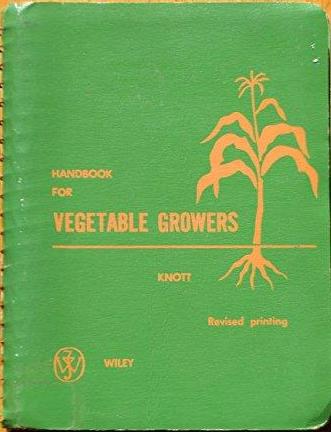
Book Recommendation -  KNOTT'S HANDBOOK FOR VEGETABLE GROWERS


This is not really a new book, but it might be a new book to most backyard vegetable gardeners.  If nothing else, just a brief scanning  of it easily  dissipates any notion that farming is a simple activity...

1957 edition.
Since it was published in 1957 by James Edward Knott, a Professor of Agriculture at the University of California, this little green, spiral bound volume has been a mainstay reference manual for commercial growers. Prof. Knott has passed on, but his  handbook has continued to find new editors.  The current edition, although dating to 1997 and still in print from Wiley-Interscience, is now edited by Donald N. Maynard and George J. Hochmuth.

Cover from latest edition (1997)
Knott's volume provides farmers with  practical  information  such as how many seeds are needed by weight or number for different spacings per acre  for specific crops. It includes comprehensive listings of pests and diseases affecting for most vegetables and the  effectiveness of  remedies (albeit usually herbicides or pesticides).  There are also tables and advise about calculating how much fertilizer or soil amendments that might be needed per acre for particular vegetables as well as data on the composition of typical manures and other organic materials, i.e. fish meal, vetch hay and buckwheat straw, that might be added to soils.

Growers can also  look up  how many  feet per minute that a tractor travels at varying low speeds starting at 1 mile per hour, or they can review charts showing how much water is needed to penetrate to difference depths in an acre based on soil type.  The handbook also covers average crop yields, what parts of a vegetable are marketable and the necessary associated storage conditions for it. There is even a section that shows the   nutrient value provided by different vegetables. For us backyard gardeners, it is an education into the complexity of the factors that farmers must take into account before, during and even after when the seeds and plants are in the ground.

In researching background information for this post, I came across a surprisingly wide variety of options about how you can get a copy of Knott's Handbook. You can buy the current edition from Wiley-Interscience for about $100 or get an Amazon Kindle edition is a little less.  Used book copies range typically from $5.00 to $20.00, but I saw one seller on eBay asking $200+ for a first edition.  I also came upon alternatives to these options that might interest the local farming community or other frugally minded types.  There are public electronic versions of the current 1997 edition available from Internet Archive as well as this PDF version available from the website of the University of Missouri's Extension Service.

FWIW:  The Internet Archive (www.archive.org) is a marvelous resource of the Internet providing open public access to millions of digital resources including folk music, videos, books etc. To get you hooked, a few of the specific resources are the Grateful Dead, Old Time Radio Shows, and TV News.  CHECK IT OUT...


And remember:

"Farming is a profession of hope." - Brian Brett, Canadian Author


THE NEW WORST BLUEBERRY PEST - Rhagoletis mendax


In May, we posted an old Root Concerns article about blueberries' preference for acidic soils;  and, in case you are still just thinking about blueberries or  have more questions now after planting them, I  recommend  your checking out this very readable  guide from the University of Maine's Cooperative Extension.

But,  now it's July and blueberries are starting to ripen throughout the Capital District.  If you've grown blueberries for a while, you probably already have them under some kind of a bird netting arrangement.  If not, the birds say thanks.  My mother-in-law, who lived in Maine,  used to just drape netting over her high bushes (6+ feet) and then crawl under the netting to pick. She always  got a lot of berries and didn't mind sharing those berries located just under the netting with the birds...  However, if you are planning to build a frame for netting, make sure that your netting is securely fixed to the ground in order to stymie both the more clever birds and  the pernicious squirrels from finding easy low level access. 

Blueberry maggot flu lavae devastate berries. Photo: sercadia.wordpress.com
Unfortunately, more than just birds like blueberries.  Many insects look at some part of blueberry bushes for a meal, but there are three  pests that  focus on consuming the fruit -- the blueberry maggot fly, the cherry fruitworm and the cranberry fruitworm.

Of these three, the newest pest that has only recently  established itself in the Capital District including Rensselaer County is the blueberry maggot fly (Rhagoletis mendax). This villain is very, very  small --   the maggots that live inside of a berry only measure 5 - 8 millimeters in length.   Given their  tiny size, you  probably might not notice either the eggs or  the newly hatched maggots in the berries. This means that  occasionally you may be ingesting a little extra protein along with your berries and cream.  Anyway, after about  three weeks of feasting those maggots  emerge from the berries (whose pulp has  now turned into a  noticeable brown mush), drop to the ground to pupate, and turn into the flies that are eager to start the next generation.  The adult flies are about 3/16" in length; and if your eyes are sharp enough to spot one, look for the black stripes on its wings to confirm your misfortune. Because the last generation of the season buries itself 1 - 6 inches into the soil to overwinter, just cleaning up under the bushes doesn't help. I don't know if covering the ground under your bushes with  landscaping cloth would serve as  an effective prophylaxis. It seems that it might.  [Are there any berry experts who can comment about this idea?]

Adult blueberry maggot fly. Source: Jerry A. Payne USDA/ARS
As for the two other insect pests affecting the blueberries, the cherry and cranberry fruitworms are present in the area and can cause serious damage.   The telltale clue of cranberry fruitworms is a web that the worms spin linking the berries in a cluster a little more securely together. The  lavae also drop to the ground to pupate and turn into moths. In this case,  keeping the ground clear under the bushes will reduce their population, and Bacillus thuringiensis (B. t.) can be used on the berries as a control.  


The cherry fruitworm, also a moth, produces just a single generation a year.  Eggs are laid on the surfaces of unripe fruit, and upon hatching the lavae bore into the fruit to feast.  Cherry fruitworms can be controlled by pyrethrin and Bacillus thuringiensis. Because cherry fruitworms overwinter by seeking out protected spots on stems, regular pruning to remove older stems can help control their numbers.

For gardeners trying to follow organic principles, controlling the blueberry maggot is especially challenging.  Traps may be able to control  the cherry and cranberry fruitworms in backyard berry patches, but are  unlikely to  be effective against the prolific maggot fly. Farmers  only use   the traps to indicate if they  have infestations and not for control purposes.  I did stumble upon one note that suggested regularly spraying the fruit with a cayenne solution, but I found no confirming research  about using this elixir for this purpose.  


If you have an infestation of maggot flies, multiple applications of an insecticide appear to be the recommended solution (probably, the only solution).  Organic insecticides, e.g. Neem oil or pyrethrin, can reduce maggot populations, but they  will also collaterally kill beneficial insects. Because the maggot's life cycle is just a few weeks, multiple applications of an insecticide are required throughout the berry season.  The bottom line for the backyard gardener may be simply to look a little more carefully before you pick and maybe not so much before  you  bite into the muffin...


FWIW:  Blueberries are native to North America. 


And remember...

"The darker the berry, the sweeter the juice." - Thomas Jefferson


GARDENING UPDATES: Thrips, Pollinators and Agroecology

Back from the much, much  cooler West Coast. The East now has the heat; and, as gardeners know, the bugs...

Recently, we posted a short article on a unique way to control flea beetles.  You can recognize their  damage  by  spotting the small, buckshot size holes  they make in leaves while dining.   Flea beetles  are sort of easy to see as they are about 1/8" long,  round and usually brown or  black.

Thirps - egg to adult  Source: MSU
Another common pest that backyard gardeners will be encountering whose activities also show up on foliage are thrips.

Thrips do not look like flea beetles. They are very small insects (1 mm, i.e. 1/25 of 1 inch in length). The adults deposit eggs inside of leaves. The young emerge and reach adulthood in about 30 days ready to start a new generation. As summer temps increase, they even develop faster and, of course, breed faster... Their fecundity can quickly reach epidemic proportions in small gardens and on farms.

Infected leaves from thrip piercings. Source: Cornell U
Leaf damage from thrips appears different from that of flea beetles,  but can lead to similar results.  Thrips make tiny piercings into  leaves in order to suck plant juices.  These piercings also expose plants to many possible viral and bacterial infections as shown in the  photo.

Organic control solutions include 1) keeping soil under plants clear of debris because this is where thrip lavae go to pupate (so this is not so practical if you mulch;  row covers and landscaping cloth may be better solutions),  2) using beneficial insects like ladybugs, 3) deploying sticky traps; and 4) if you're not using beneficial insects, consider applying insecticidal soap sprays or natural insecticides like Neem oil as a last resort because these can also kill beneficial insects like bees.

A  recent video produced by Cornell's Eastern New York Horticultural   Program and  available from  Rensselaer County Extension's Facebook site explains how to recognize thrip damage as well as ways  to control thrips.


BTW: Rensselaer County Extension's Facebook site is a great source for information about all aspects of gardening.  We've  added it to the Related Resources links on the right side of this page.


Pollinators  & Neonicotinoid Update

Neonicotinoid compounds comprise the largest  group of insecticides used around the world today; and, in case you missed it, back in April, 2018 the European Union permanently banned the use of the three most commonly used neonicotinoids from outdoor use by farmers.   The EU's action recognized that the growing body of research (e.g. Cornell's research summary)  associating these chemicals with the decline in pollinator populations is simply too strong to be ignored. This is both good and bad news for European and British farmers - those growing certain field crops such as soy beans and corn are not happy; those raising crops that are highly dependent upon insects for pollination like fruits and many veggies are happy.

Source: USDA

The status of "neonics" in the U.S. varies.  The U.S. Fish & Wildlife Service in the Northwest has stopped using them in 2016on its feed crops for wild animals, and a few states  also have banned them. New York has been considering a ban since 2016, but so far proposed legislation has not made it to either the Senate or Assembly floor for action leaving the NYS Dept. of Environmental Conservation just to promote a "best practices" approach towards limiting the use of "neonics" in the state.

Like many issues there are competing needs and interests.  Neonicotinoids can be sprayed on plants,   soaked into the ground around plants or used as coatings on seeds. They do not directly affect animals and birds as earlier insecticides did, but "neonics" do directly affect a few important groups of insect pests that are the bane of some farmers and turf managers (think golf courses & sport fields). 

Neonicoinoids are absorbed by plants and then ingested by munching and sucking insects whose "brains" subsequently become fatally impaired.  Birds are indirectly affected by having to cope with reduced insect populations -- they have less to eat. Honey bees and their kin pollinators seem to be affected by some of the residual compounds of neonicotinoids. -- Research also indicates that "neonics" may not decompose as quickly or as thoroughly as advertised and that there is also a leaching problem of these compounds into adjacent areas.  This is both a problem for organic farmers as well as  the natural environment.

WHAT YOU CAN DO  - The three most used "neonics" are imidacloprid, thiacloprid and clothianidin that are used extensively in agriculture, ornamental nurseries and incorporated into popular insecticides available to the general public.  To minimize the impact of these compounds on the environment, you can 
  • Avoid buying insecticides that lists one or more of these ingredients. 
  • Plant native plants in your garden and maybe even some plants  considered to be weeds like milkweed, mullen or Queen Anne's lace for  bees and other pollinators. 
  • And finally, buy organic whenever you have a choice.


Agroecology - A New Farming Movment

Finally, FWIW: Recently an opinion piece in the New York Times,"Bringing Farming Back to Nature" by Daniel Moss and Mark Bittman (NYT June 26, 2018), introduced a new word to me, agroecology. The term identifies a growing world wide movement to incorporate  ecological principles into agriculture. 

Daniel Moss leads the AgroEcology Fund, an organization funding sustainable agriculture throughout the world. Mark Bittman, who needs little introduction to foodies now also spends time outside of the kitchen promoting healthy eating and sustainable agriculture.  This short article worth a checking out to learn about  ongoing efforts to move away from the monocultural farming model -- a little hopeful news is getting harder to find...

FIVE FACTS ON GARTER SNAKES


Did you know that garter snakes (Thamnophis sirtalis sirtalis) are among the most common snakes in North America? They are usually 23-30 inches long but have been known to grow up to 53 inches long. 
Common Eastern Garter Snake.  Source: Public Domain

Garter snakes hibernate in the winter, much like a bear.

Unlike most snakes which lay eggs, garter snake babies are born alive. The breeding time is usually
in the late summer when the temperature is conducive. The garter snakes have been known to give birth to around 20 and 40 babies per litter. That’s a lot of snakes.

Garter snakes are harmless, although many people are afraid of them anyway. Their only form of
defense against us is a foul-smelling musky liquid that they release if picked up.

The garter snakes play a vital role in the garden’s ecosystem. When in the garden, the garter snake
usually feeds on  frogs, earthworms and  mice. This helps in the reduction of  crop
damage.


Text by Don Maurer, Master Gardener of Rensselaer County Cooperative Extension.